
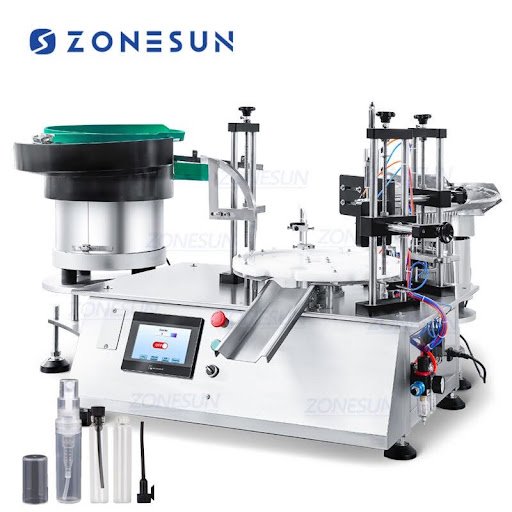

High-volume manufacturing requires packaging equipment capable of maintaining consistent production speeds while accurately filling containers. A rotary filling machine is designed for continuous or high-speed filling operations and is commonly used in industries such as beverages, food, cosmetics, chemicals, and other liquid-product manufacturing.
Instead of moving containers through a single filling position one at a time, a rotary system uses a rotating carousel that carries multiple containers through different stages of the filling cycle. This design can allow several containers to be processed simultaneously.
What Is a Rotary Filling Machine?
A rotary filling machine is an automated filling system that uses a circular arrangement of filling stations or valves.
Containers are fed into the machine and positioned around a rotating platform. As the platform rotates, containers pass through the filling area, where each one receives a predetermined quantity of product.
After filling, containers exit the machine and continue to the next packaging stage.
The number of filling heads can vary depending on the machine design and required production capacity.
How the Rotary System Works
Empty containers enter the machine through an infeed conveyor or handling mechanism. A timing system positions the containers correctly before they enter the rotating filling section.
The rotary carousel then moves the containers beneath the filling valves. Product is dispensed according to the selected filling method.
Once filling is complete, the containers are transferred to an outlet conveyor.
Because multiple containers are handled during each rotation, rotary machines can support relatively high production rates when properly configured.
Filling Technologies
Different products require different filling methods. Rotary machines can be designed around several technologies.
Gravity filling can be suitable for certain low-viscosity liquids where controlled flow is sufficient.
Pressure filling can help handle products that require controlled pressure during the filling process.
Volumetric systems dispense a defined volume, while flow-meter-based systems can monitor the amount of product passing through the filling system.
Piston-based systems may be used for thicker products where controlled mechanical displacement is required.
Advantages of Rotary Filling Machines
A major advantage is production capacity. Multiple filling heads can operate during each rotation, allowing manufacturers to process numerous containers within a relatively short period.
Rotary designs can also provide consistent container handling. Automated positioning reduces the need for operators to manually place each container under a filling nozzle.
The machines can also be integrated with other packaging equipment, creating a continuous production line.
Industries That Use Rotary Fillers
Rotary filling equipment is commonly associated with beverage production, where large quantities of bottles may need to be filled quickly.
Food manufacturers can use rotary machines for suitable liquid products such as sauces, oils, and other formulations.
Cosmetic manufacturers may use rotary filling equipment for shampoos, lotions, and other liquid or semi-liquid products.
Specialized rotary systems can also be developed for certain industrial and chemical applications.
Container Compatibility
Container size, shape, and material influence machine configuration.
Some machines are designed primarily for glass bottles, while others handle PET, plastic, metal, or other containers.
When purchasing a rotary filling machine, manufacturers should identify the container dimensions and determine whether multiple container formats will need to be processed.
Changeover requirements are important for facilities that produce different products or package sizes.
Filling Accuracy
Accurate filling helps manufacturers maintain product consistency and control material usage.
The filling method, product characteristics, machine configuration, and operating conditions can all affect accuracy.
Regular calibration and maintenance can help maintain consistent performance. Operators should also monitor filling results and make adjustments according to the manufacturer’s procedures.
Cleaning and Maintenance
Maintenance is essential for keeping rotary filling equipment operating effectively.
Product-contact components should be cleaned according to the requirements of the product and industry. Food, beverage, pharmaceutical, and cosmetic applications may have specific sanitation requirements.
Mechanical components such as bearings, conveyors, valves, and drive systems may also require regular inspection and maintenance.
Proper cleaning and preventive maintenance can help reduce downtime and extend equipment service life.
Automation Features
Modern rotary filling machines can include sensors, PLC controls, touchscreen interfaces, and automated monitoring systems.
Sensors can detect container presence and help prevent filling cycles from occurring when a container is missing or incorrectly positioned.
Operators can use control interfaces to adjust filling parameters, machine speed, and other settings.
Advanced systems may also record production information and provide alerts when maintenance or operator attention is required.
Selecting a Rotary Filling Machine
Before purchasing equipment, businesses should determine the required production rate, product characteristics, container dimensions, filling volume, and available floor space.
The manufacturer should also provide information about filling accuracy, compatible products, cleaning procedures, changeover times, and maintenance requirements.
It is useful to consider future production needs as well. A machine that meets today’s requirements may become insufficient if production volume increases significantly.
Conclusion
A rotary filling machine is a practical solution for manufacturers that need automated and high-volume container filling. Its rotating structure allows multiple containers to move through the filling process simultaneously, supporting efficient production.
The appropriate machine depends on product viscosity, filling volume, container type, required speed, accuracy, cleaning requirements, and production-line configuration.
By carefully evaluating these factors, manufacturers can select rotary filling equipment that fits their packaging operation and supports consistent, efficient production.