
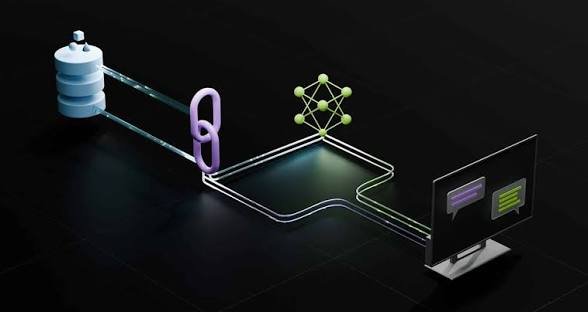

LLMs are very good at summarising, drafting and reasoning on what they’ve learned during their training. The vast majority of enterprise questions though are about internal docs (policies, SOPs, product notes, contracts, tickets, runbooks, project wikis etc). If the model can’t “see” those then it’s likely to give an answer with the wrong or incomplete context. RAG is the solution to this as it connects the LLM to a private knowledge base at query time, thus grounding the answer in the organisation’s own data.
Lots of people doing applied GenAI as part of an Artificial intelligence training in Hyderabad very quickly come to the realisation that RAG is one of the most practical patterns for enterprise use as it improves accuracy without the need to retrain the base model at all.
What RAG Is and Why Enterprises Need It
RAG is a system design pattern in which you have an LLM paired with a retrieval layer. The user asks a question and the system first retrieves the relevant internal content, then asks the model to answer the question using that retrieved content. The model is not just “guessing” from memory; it’s producing an answer based on the evidence that’s in the prompt.
This approach addresses common enterprise needs:
- Private data access: there’s no internal policy or proprietary knowledge in the public training data.
- Freshness: the docs change all the time and RAG can use the most up to date versions.
- Auditability: Retrieved passages can be logged and reviewed for compliance.
- Lower cost than fine-tuning: lots of tasks only require good grounding rather than new model behaviour.
In short RAG reduces hallucinations by ensuring the model is drawing on the relevant internal sources.
How Vector Databases Make Retrieval Work
Enterprise knowledge is predominantly unstructured text. A traditional keyword search will often fail to retrieve the right information if the exact wording is different (e.g. ‘annual leave’ vs ‘paid time off’). Vector databases enable semantic search which helps the system to find what you’re looking for based on intent rather than just the literal words you use.
The key idea: embeddings
An embedding model takes text and turns it into a vector (a list of numbers) which represents the meaning of that text. Texts with similar meaning will be close together in vector space. When a user asks a question the system will embed the question, perform a search for the most similar vectors and return the most relevant text chunks.
What gets stored in a vector database
Typically, you store:
- Chunked document text (small sections, not full PDFs)
- An embedding for each chunk
- Metadata (document title, source system, owner, version, access labels, timestamps)
This combo enables very fast retrieval and useful filtering. You can for instance filter your results to just “HR policies” or just “customer contracts” using the metadata filters.
A Practical RAG Architecture for Private Knowledge Bases
A clean RAG pipeline has a few standard steps, the specifics will vary but the logic is the same.
Step 1: Ingestion and chunking
Docs are pulled from the various internal systems (SharePoint, Confluence, Google Drive, CRM notes, ticketing tools etc). They’re then cleaned up and split into chunks. Chunking is important as the model has a limited context window. The chunks need to be good chunks i.e. they need to be coherent, have a single main idea and where possible we want to keep the headings and tables as plain text.
Step 2: Indexing with embeddings
Each chunk is embedded and stored in the vector database. A versioning strategy is key. If a policy changes you should re-index the new version of the section and mark the old version as inactive rather than just leaving the old version(s) sitting there as duplicates.
Step 3: Retrieval and reranking
At query time the system retrieves the top-k chunks based on similarity. Many production systems will have a reranker as well which uses a second model to score the retrieved chunks more accurately. This can be a big improvement in terms of relevance when you have large documents or complex wording.
Step 4: Grounded generation
The LLM is prompted with the retrieved passages and asked to answer based solely on that context. Good prompts will include instructions such as:
- Cite which passage supports each claim (internally, even if you do not show it to users)
- If the answer is not in the context, say so and suggest the next step
- Follow enterprise tone and formatting rules
Governance, Security, and Quality Controls
RAG is not just a technical build. You’ve got to manage access, risk and quality.
Access control and data boundaries
The retrieval layer must respect permissions. If a user doesn’t have permission to view a document in the source system then the RAG system should not retrieve that document for them. That’s normally achieved by storing and enforcing access metadata on a per chunk basis.
Reducing leakage and unsafe answers
Common safeguards include:
- Removing secrets from indexed content (keys, passwords, tokens)
- Using policy filters to block certain categories (legal holds, restricted HR notes)
- Logging retrieved sources for audits
- Running red-team tests for prompt injection (malicious text inside documents)
Measuring quality
RAG systems should be assessed on retrieval quality and answer faithfulness. Appropriate metrics would be answer accuracy against a test set, citation precision and “no answer” correctness in the case where there’s no evidence to support the answer.
Conclusion
RAG is a very practical way of connecting LLMs to private enterprise knowledge bases, keeping the data up to date, under control and explainable. The vector databases enable semantic retrieval so you can find the right information even if the phrasing is different. With good chunking, good retrieval and appropriate governance you can support a range of high value use cases including policy Q&A, customer support assistance, internal IT support and analytics help desks.
For teams actually building real deployments an Artificial intelligence training in Hyderabad can be a useful starting point, but again long term success is down to engineering discipline: clean data pipelines, permission aware retrieval, proper evaluation and ongoing monitoring of the groundedness of the responses.