
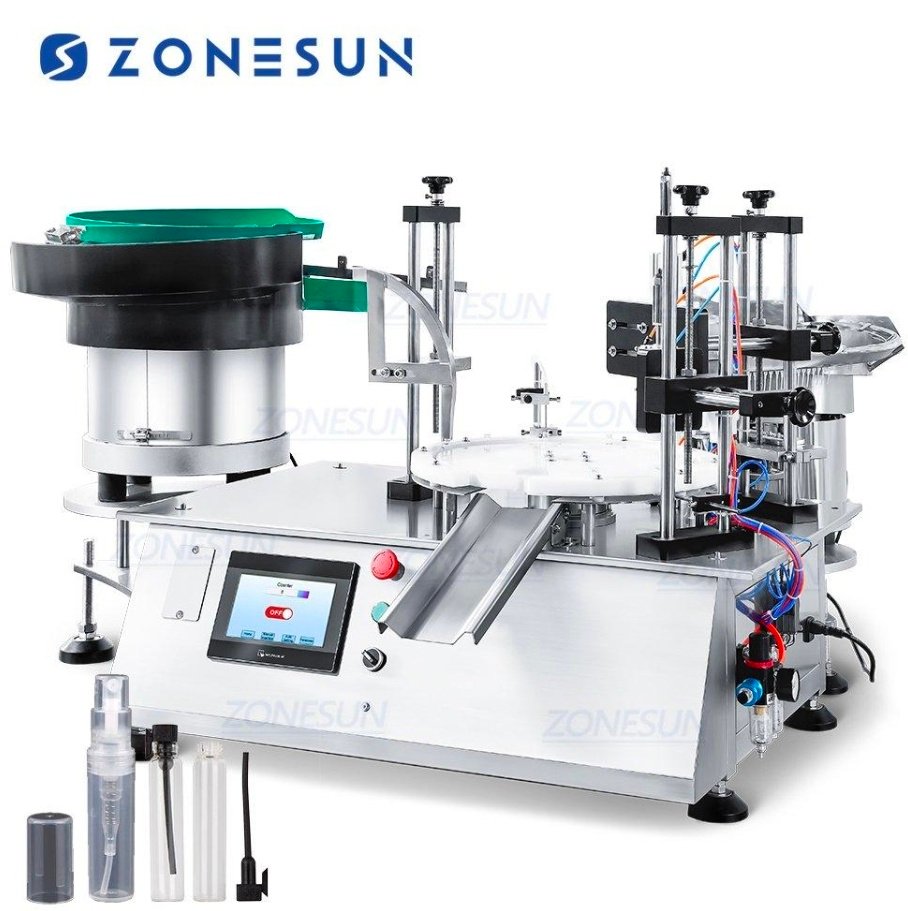

If you have ever picked up a bottle of perfume, sauce or medicine, the odds are that a machine filled it and put the cap on, not a person. A bottle filling and capping machine does both jobs in one line: it measures the liquid into each bottle and then fits and tightens the cap, all without stopping. For a small producer it is often the first piece of automation that makes a real difference to output.
Zonesun makes a wide range of these machines, from compact units for perfume sampler bottles and glass vials to larger lines that handle filling, capping, sealing and labelling together. The basic idea is the same at every size, though. Bottles go in empty, and they come out filled, capped and ready for the next step.
The filling stage: getting the right amount in every bottle
Filling starts with the bottles moving along a conveyor into position under the filling nozzles. The machine measures out the liquid for each bottle, using a pump or a piston that delivers the same volume every time. That consistency matters more than speed: a bottle that is overfilled wastes product, and one that is underfilled will be rejected or will disappoint the customer who opens it.
Different liquids need different filling methods. Thin liquids such as water or perfume flow easily and can be filled quickly, while thick liquids such as creams or sauces need a slower, more forceful push. Some products foam, some are sensitive to air, and some need to be filled in a clean environment. Machines built for glass vials, for example, can include laminar airflow to keep the filling area clean, which matters for pharmaceutical and cosmetic products.
The capping stage: a tight seal, every time
Once filled, the bottle moves to the capping head, which places a cap on the neck and tightens it to a set torque. That torque setting is important: too loose and the bottle may leak in transit, too tight and the customer will struggle to open it, or the cap may crack. A good machine holds that setting steady across thousands of bottles, which is something hand capping can never match.
Caps come in many forms, from simple screw caps to spray pumps, droppers and press-on lids, and the capping head must match the cap type. Some machines handle one cap style only, while others can be changed over with different heads or tooling. That changeover time matters for a producer who runs several products on the same line, since every minute spent adjusting the machine is a minute it is not producing.
How the two stages work as one line
The value of a combined machine is that the two stages are timed together. Bottles do not pile up between filling and capping, and there is no hand carrying of open bottles, which keeps the product cleaner and the line faster. A monoblock design puts both stages in a single frame, which saves floor space and makes the timing simpler to control.
From there, a line can grow. A bottle turntable can feed empty bottles in an orderly stream, a labeller can add the label after capping, and a conveyor can carry finished bottles to packing. Each addition is optional, which is why many producers start with a filling and capping machine and add the rest as their volumes grow. The combined machine is the heart of the line, and the other equipment works around it.
Choosing between semi-automatic and fully automatic
Not every producer needs a fully automatic line. A semi-automatic machine still fills and caps, but an operator places each bottle and removes it by hand. That is slower, but it is also cheaper, easier to set up, and a sensible choice for small batches or for products that change often. A fully automatic machine takes over the handling as well, and it only pays for itself when the volume is high enough to keep it running steadily.
The right choice comes down to honest numbers: how many bottles a day, how many different products, and how much floor space and labour are available. A machine that runs for two hours a day is an expensive ornament, while a semi-automatic unit worked to its limit becomes a bottleneck. Matching the machine to the real workload is the decision that matters most.
A filling and capping machine is simple in concept and demanding in practice. It must measure accurately, seal consistently, and keep pace with the rest of the line without spilling a drop. When it does those things well, it disappears into the background of a production day, which is exactly what good equipment should do. The bottles just keep coming, filled to the same level and sealed to the same tightness, one after another.