
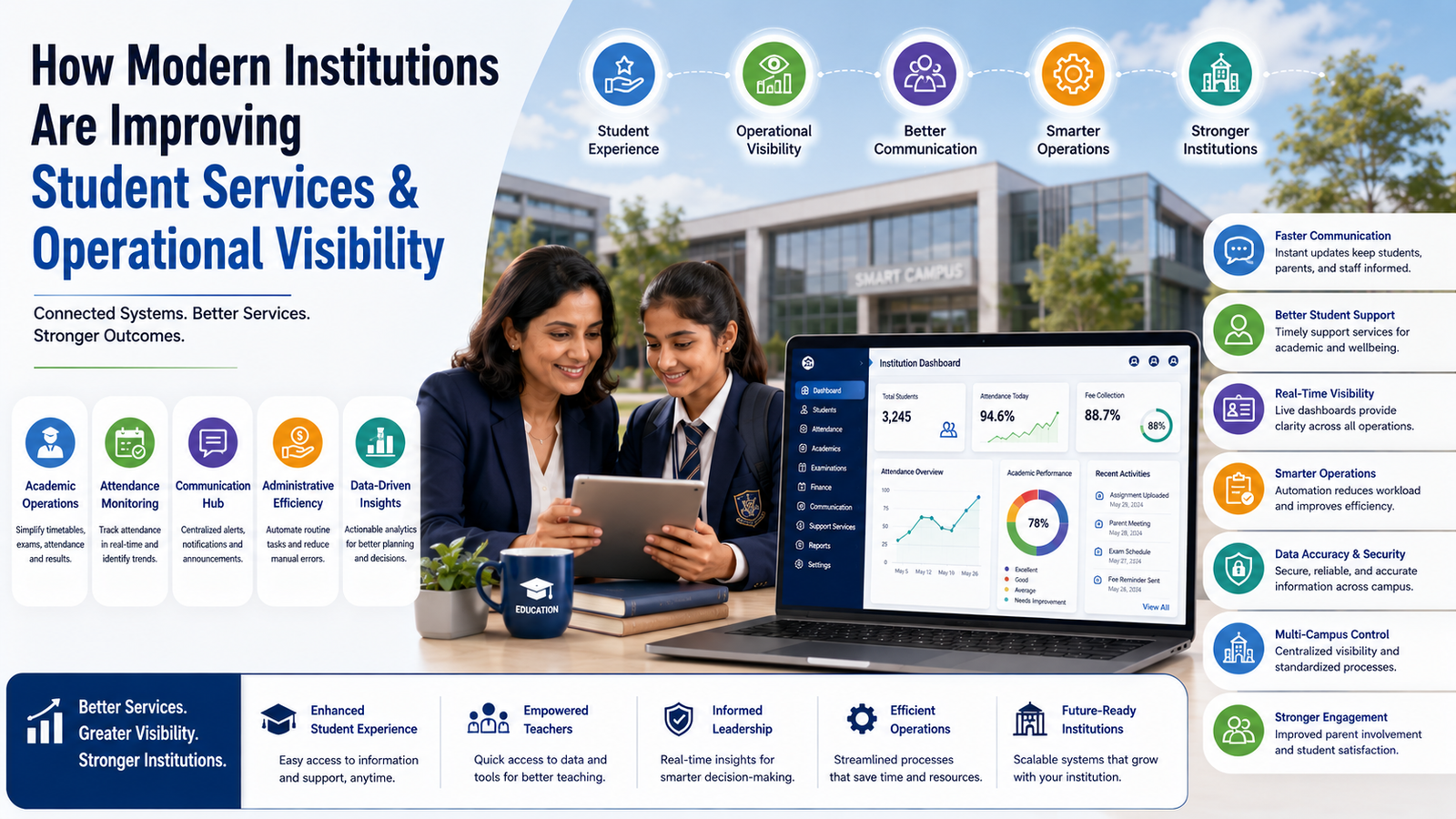

Educational institutions are evolving rapidly to meet growing academic and operational demands. Schools are no longer focused only on classroom learning. They must also manage communication, administration, student support, reporting, and campus coordination efficiently. To improve these areas, many institutions are implementing Student Information System Software that helps centralize operations and provide better visibility across departments.
Why Student Services Are Becoming More Important
Modern schools understand that student experience extends beyond academics.
Students and parents now expect:
- Faster communication
- Easy access to information
- Transparent processes
- Efficient support services
- Better academic coordination
Traditional administrative methods often struggle to meet these expectations.
Manual systems create delays and increase operational pressure for school staff.
Educational institutions are therefore investing in digital platforms that improve responsiveness and simplify service delivery.
The Growing Need for Operational Visibility
School leadership teams require clear visibility into daily operations.
Without centralized information, administrators may struggle to monitor:
- Attendance trends
- Academic performance
- Fee collection
- Student support activities
- Staff coordination
Manual reporting systems often delay important insights.
Modern digital platforms provide real-time access to operational information across the institution.
This helps leadership teams make faster and more informed decisions.
Improving Student Support Services
Student support has become a major priority for educational institutions.
Schools now focus on creating more organized and responsive environments for students.
Digital systems help institutions improve:
- Academic support coordination
- Attendance monitoring
- Counseling management
- Communication processes
- Student record accessibility
When information becomes easier to access, schools can respond to student needs more effectively.
This creates a smoother and more supportive educational experience.
Simplifying Daily Academic Operations
Educational institutions manage many academic activities throughout the year.
These include:
- Timetable management
- Examination coordination
- Attendance tracking
- Assignment management
- Result processing
Manual coordination often creates operational inefficiencies.
Digital platforms simplify these activities through centralized management systems.
Many schools also implement campus management system platforms to connect academic, administrative, and communication processes within a single environment.
This improves coordination and reduces administrative delays.
Faster Communication Improves Student Experience
Communication plays an important role in student satisfaction and operational efficiency.
Students and parents expect timely updates regarding academic and administrative activities.
Traditional communication methods often create delays and confusion.
Digital systems improve communication through centralized notification tools.
Schools can quickly share:
- Examination schedules
- Attendance alerts
- Assignment reminders
- Event announcements
- Academic updates
This helps institutions maintain stronger engagement with students and families.
Better Attendance Monitoring
Attendance tracking provides valuable insights into student engagement and academic participation.
Manual attendance systems often create reporting delays and inconsistencies.
Automated attendance platforms improve operational visibility by updating records instantly.
Administrators and teachers can monitor:
- Daily attendance trends
- Student participation levels
- Section-wise attendance performance
- Campus-wide attendance data
This helps institutions identify concerns earlier and improve student support strategies.
Enhancing Transparency Across Departments
Educational institutions depend on coordination between multiple departments.
Academic teams, finance staff, administrators, and support departments all require access to reliable information.
Disconnected systems often create communication gaps and reporting inconsistencies.
Centralized digital platforms improve transparency by allowing departments to access shared information in real time.
This strengthens operational coordination and improves institutional efficiency.
Supporting Multi Campus Institutions
Educational groups operating multiple campuses face greater operational complexity.
Managing student services separately at each branch often creates inconsistencies.
Leadership teams require centralized visibility into operations across locations.
Digital platforms help institutions standardize:
- Student support processes
- Communication workflows
- Academic reporting
- Attendance management
- Administrative coordination
This improves operational alignment and strengthens institutional control.
Improving Administrative Efficiency
Administrative teams handle a large number of repetitive tasks every day.
These tasks may include:
- Admissions processing
- Attendance updates
- Fee management
- Report preparation
- Communication follow-ups
Manual workflows increase workload pressure and consume valuable time.
Automation reduces repetitive activities and improves operational speed.
This allows staff members to focus more on student support and institutional planning.
Helping Teachers Access Information Faster
Teachers require quick access to academic and student information.
Manual systems often make information retrieval slow and inefficient.
Digital platforms help teachers:
- Access student records instantly
- Upload grades quickly
- Track attendance digitally
- Share assignments online
- Communicate with parents efficiently
This reduces administrative burden and supports better classroom management.
Teachers can focus more on student engagement and learning activities.
Supporting Data Driven Decision Making
Modern educational institutions increasingly rely on data for operational planning.
Leadership teams require accurate insights into institutional performance.
Digital systems provide real-time dashboards that help administrators monitor:
- Enrollment trends
- Academic performance
- Operational activities
- Resource utilization
- Student engagement patterns
This improves planning quality and helps institutions respond faster to operational challenges.
Improving Resource Management
Schools manage many operational resources daily.
These include:
- Classrooms
- Laboratories
- Teaching staff
- Academic materials
- Transport services
Without centralized visibility, resource planning becomes difficult.
Digital systems help institutions allocate resources more effectively based on actual operational requirements.
This improves efficiency while reducing scheduling conflicts and operational waste.
Strengthening Parent Engagement
Parents expect greater involvement in their children’s education.
Schools now require communication systems that provide regular academic and operational updates.
Digital platforms improve parent engagement by offering access to:
- Attendance records
- Examination schedules
- Academic performance updates
- School announcements
- Fee reminders
This creates stronger trust between families and educational institutions.
Improved communication also supports better collaboration between parents and teachers.
Reducing Operational Errors
Manual systems often increase the risk of:
- Duplicate records
- Data inconsistencies
- Reporting delays
- Communication mistakes
Centralized digital platforms improve operational accuracy through shared databases and automated synchronization.
When information updates in one department, it becomes visible across the institution instantly.
This reduces operational confusion and improves data reliability.
Preparing Institutions for Future Growth
Educational institutions continue expanding their digital capabilities.
Schools now require systems that support scalability, operational efficiency, and connected learning environments.
Manual processes often limit institutional flexibility and growth potential.
Digital platforms provide the infrastructure needed to support long-term operational development.
Schools can manage increasing student populations and expanding campuses more efficiently through centralized systems.
Why Operational Visibility Matters for the Future
Operational visibility has become essential for modern education management.
Leadership teams must understand institutional performance in real time to support strategic planning and continuous improvement.
Schools that lack centralized visibility often struggle with delayed reporting and operational inefficiencies.
Connected digital platforms provide the transparency needed for effective management.
This supports stronger decision-making and institutional accountability.
Building More Connected Educational Environments
Educational institutions are moving toward more connected and responsive operational models.
Schools now require systems that support collaboration, communication, academic coordination, and operational transparency.
Modern institutions are focusing on creating environments where students, teachers, administrators, and parents remain connected through centralized digital platforms.
Institutions investing in operational visibility and student-focused services are better prepared for future educational demands.
As educational environments continue evolving, connected systems will play an even greater role in improving institutional efficiency and student experience. Many schools begin this transformation through Student Information System Software and integrated digital management platforms that centralize operations while improving visibility and service delivery across the institution.