
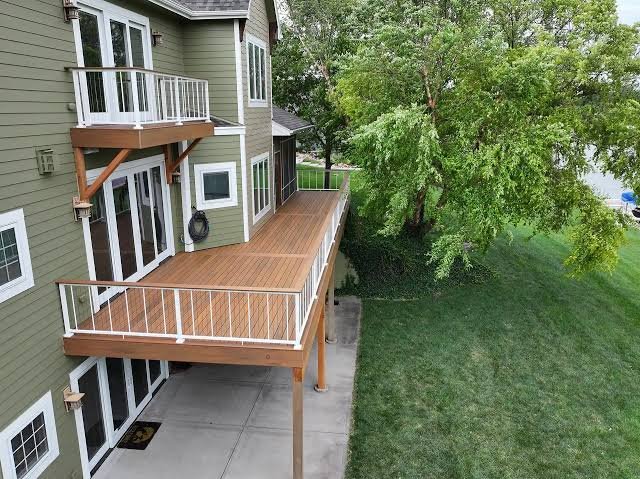

A lasting deck starts underground. A lasting deck shrugs off a Nebraska February without a groan. A lasting deck is, honestly, a little boring to look at once it is finished. None of that gets decided by the railing profile you circle in a brochure. It gets decided by the footings, the ledger, and the wood. That is why the deck builders omaha ne homeowners recommend will talk about drainage and frost before they mention color. The truth most people miss is that a deck’s lifespan is settled long before the first board is ever screwed down.
The Deck Is Decided Below the Frost Line
Around Omaha the frost line sits roughly 42 inches down, and a footing that stops short of it will lift a little every winter as the ground swells and settles. That heave is what pulls a ledger, which is just the board that ties the whole deck back to the framing of the house, loose from the wall over time. Skip the depth and the deck telegraphs the problem within a season or two. In practice, the failures we see most often trace straight back to shallow footings and a ledger that was nailed on instead of bolted. The American Wood Council’s DCA 6 deck guide calls for a guardrail at least 36 inches tall on any surface more than 30 inches off the ground, with balusters set so a 4 inch sphere cannot slip through. Those figures are not decoration. A guard that fails an inspection is the same guard that fails a kid leaning on it.
Aging decks are the quiet risk here, not just new builds. The North American Deck and Railing Association ran its annual Deck Safety Month in May 2026, and the reminder the group puts out every spring still lands: a deck more than a few years old earns a hard look at the ledger and the footings before the summer crowd arrives. Most homeowners never crawl under to check. That is usually where the trouble has been hiding all along.
The Wood You Pick Sets the Maintenance Bill
Cedar, treated pine, and composite each age differently, and picking on looks alone is the regret we hear about most. Cedar shows off the first year, then weathers to a soft silver gray if it never gets sealed. Composite costs more up front and asks almost nothing of you afterward. Underneath all three, though, the real variable is moisture. Oregon State University’s extension guidance on wood puts the danger line at 20 percent. Lumber held below 20 percent moisture content is far less inviting to the fungi and insects that rot a deck from the joists up. That is why the deck builders omaha ne homeowners keep rehiring will fuss over flashing and board gaps, plus the airflow underneath, long before anyone argues about stain color.
Run the math on a mid-sized build and the tradeoffs stop feeling abstract. Take a 16 by 12 platform, which is 192 square feet. Mid grade composite boards at roughly $9 a square foot put the decking alone near $1,730. Pressure treated framing, joist hangers, and fasteners add about $1,400, and six concrete footings at $65 apiece tack on another $390. Add a permit around $120 and a modest railing run near $900, and the materials work out to about $4,540 before a single hour of labor. Labor on a build like that commonly doubles the number, so a finished deck lands in the ballpark of $9,000 all in.
A New Deck’s First Season Follows a Pattern
Here is how a straightforward Omaha build actually unfolds. The first week is demolition, layout, and footings, with a day usually lost to the inspector signing off on the holes before any concrete is poured. The second week the framing and ledger go up, and the deck finally reads as a real shape in the yard. By the third week the decking and railing are on and you are standing on it. Cedar, by the way, smells fantastic while it is being cut, one of the quieter perks of this trade. Back to the schedule: the first winter is the honest test, when a deck on proper footings sits dead still while a shallow one starts to creak and shift.
So the real choice in front of a homeowner is less about railing style and more about who handles the boring parts right. Ask how deep the footings go, ask how the ledger attaches, and ask what the wood is rated for, and you will learn more than any photo gallery can tell you. Cheap footings always come back to bite you, usually right around year three when the stairs go crooked. Get those fundamentals handled and the deck turns into the easy part of the backyard, the spot you stop thinking about and simply use.