
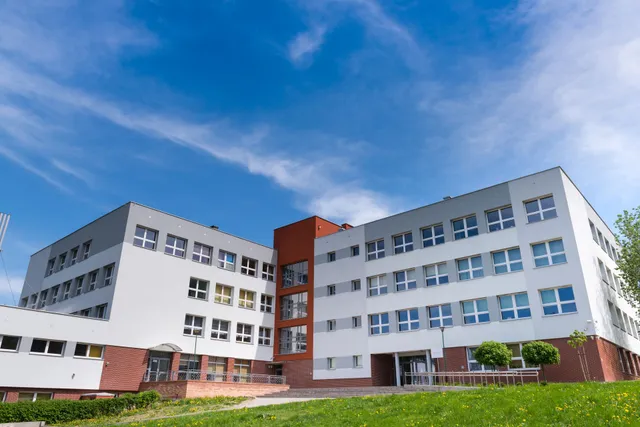

A Front Range private school called us in June with a board-approved budget and a hard August deadline to repaint 60,000 square feet of classrooms. The director had one bid that looked cheap and one that looked steep, with no way to tell which was honest. That gap is why comparing commercial painting contractors denver co schools trust has to start with what a repaint really costs. On a campus that size, the paint on the shelf is the smallest line on the whole invoice.
The real cost comes from three things: how much surface there is, how bad its condition is, and how fast the job has to finish. The paint itself barely moves the number.
Square Footage Sets the Baseline Number
Every honest estimate starts by measuring wall area, not the floor plan square footage. A 60,000 square foot campus can hold two or three times that in paintable surface once you count corridors, stairwells, and tall classroom walls. Commercial interior repaints in the region tend to run between $1.50 and $4 per square foot of wall surface, and that spread is not random. Where a job lands inside that range depends almost entirely on the next three drivers, so the baseline is only a starting point.
Surface Prep Drives Most of the Cost
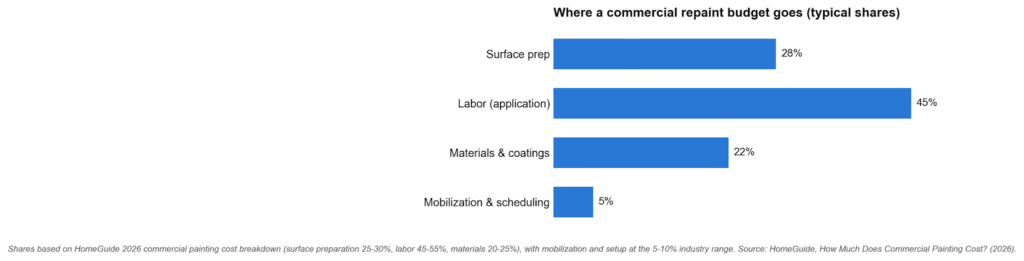
Prep is the line that separates a cheap bid from an honest one. The case we see most often on older campuses is wall damage that quietly got deferred for years, and that surface is what a crew must repair first. The University of Illinois estimates its deferred maintenance backlog for state-funded academic buildings at $795 million, and neglected surfaces do not wait for a repaint budget. Painters spec coats in mils, meaning thousandths of an inch, and a wall that is not cleaned and primed will never hold them.
Summer Windows Compress the Labor Schedule
Labor is the biggest slice of any commercial repaint budget, and the compressed summer window only makes it heavier. A job that could take eight relaxed weeks gets squeezed into five, which means more painters on the wall at once or longer shifts. That compression shows up as overtime, extra supervision, and sometimes a second crew (and yes, the calendar always wins that fight). A contractor who has run campus work before will schedule around floor refinishing and network cabling instead of colliding with either of them.
Coating Grade Changes the Ten Year Math
Coating grade is really a bet on time. A builder-grade paint might cost less per gallon than a commercial acrylic rated for scrubbing, but it can fail in classrooms years sooner. Gordian’s April 2026 State of Facilities report put deferred capital renewal on North American campuses at $156 per gross square foot. The same benchmarking work logged an 8% jump in those renewal costs in a single year. Spending a little more on the coating is usually the cheapest line over ten years, because it keeps the job from coming back early.
Running the Real Numbers on One Campus
Put the pieces together on that 60,000 square foot campus. Say the wall and ceiling surface measures 150,000 square feet after the tall corridors and stairwells are counted. At a blended $2.25 per square foot for a standard finish, the application alone runs $337,500 before any extras. Add the 28% that prep on older classrooms usually demands, then tack on another $18,000 for the weekend shifts that beat the August deadline. That brings the honest number to roughly $450,000, not the $310,000 that a gallon-only estimate quietly implied.
Budget the Whole Job Not the Gallon
The number that protects a board budget is the one that includes prep, the schedule, and the coating you actually want to last a decade. A cheap bid is not actually cheaper in the end; it just moves the surprise to August. When a district weighs commercial painting contractors denver co administrators can trust, the honest estimate is the one that shows every driver up front. Ask for the whole number, then hold the crew to the calendar.