

Last winter our shop took on two green hires during the slow season. Inside a week I had my best welder down on one knee with a chalk line and a tape measure. He is a certified fabricator with twenty years on the torch, and there he was marking hole centers on a stair railing like a first-year apprentice. The fix that finally got him back to the arc was an automated layout table driven straight off the CAD file. Once marking moved to a machine a first-week operator could run, the whole floor changed. The argument here is plain. Move layout off your skilled welders and onto a machine a beginner can run, and you buy back the most expensive labor in the building.
Skilled Welders Were Stuck Doing Chalk Work
For years nobody questioned it. Layout by hand is how railings and architectural steel have always been marked, so the person who knew the drawings best got the chalk line. The trouble is that this person is usually your highest-paid welder. Every hour he spends on his knees with a tape is an hour the torch sits cold. The pattern we see most often on a busy floor is a master fabricator burning half a shift on marking that a careful beginner could handle. New hires do not close that gap fast. On a manual bench nobody trusts a green operator with layout for months, because one mismeasured hole scraps the whole piece. Scrap that railing and you have burned steel, shop time, and the delivery schedule all at once. The Christian Science Monitor reported back in April 2026 that more than 400,000 skilled-trade jobs still sat unfilled through 2025. Trade-school enrollment is creeping up only about 6 percent a year, so waiting on a flood of experienced hands is not much of a plan.
One Marking Table Changed Who Does Layout
An automated marking table flips the question from how skilled the operator is to how good the file is. The CAD drawing loads, and an industrial marker lays down every line, hole center, and part label on the steel. No chalk, no mess, no math done on the floor. A single marker draws over a mile of line before it runs dry, so the consumable cost barely registers on a job. What that means in practice is that layout stops being a craft skill. It becomes a machine task a careful beginner can learn to run. That is the real shift an automated layout table buys you. In our shop the slow winter turned into the best time to prove it, because both green hires were standing around with not enough to do anyway. By the end of their first week, either one could load a railing job and mark it accurately while our veterans went back to welding. Neither of them had touched a marking table before that January, and the software walked them through the setup in a single afternoon. The mistakes that used to eat a morning, a transposed dimension or a hole an inch off, simply stopped showing up on marked stock. Georgia Tech’s manufacturing extension partnership reports that 75% of the manufacturers it serves employ fewer than 250 workers. Fabricated metal is its single largest client sector, which tells you how many small shops fight this exact staffing math with no bench to spare. Here is a rule of thumb that has held up for us. If a certified welder is spending more than a few hours a week on marking, then a marking table pays for itself long before anyone finishes arguing about the purchase order. Layout is the one job you should hand to your least experienced person, not your most experienced one. Watching a twenty-year fabricator crawl a shop floor with a chalk line is money left on the concrete, and it took us far too long to see it that way.
Freed Veterans Mean More Jobs Out The Door
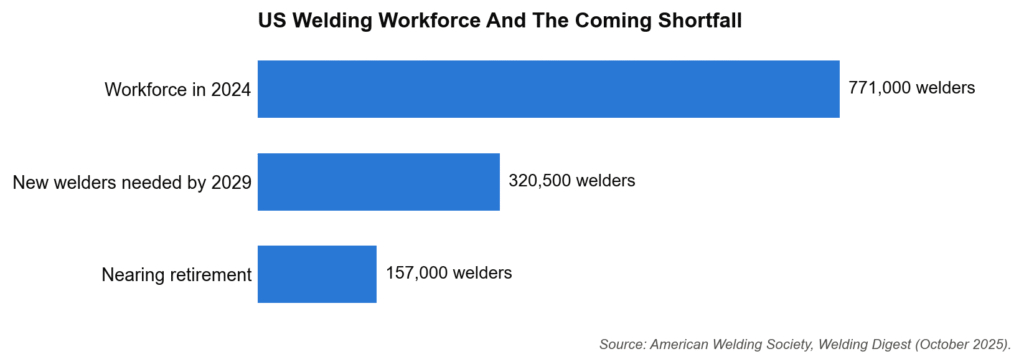
The payoff shows up where it matters, which is jobs finishing and shipping. When your veterans are welding instead of marking, throughput climbs without adding a single person to payroll. The American Welding Society’s Welding Digest put the welding workforce at 771,000 professionals in 2024. It projected 320,500 new welders needed by 2029, with more than 157,000 already nearing retirement, so the skill you have on the floor today is only going to get scarcer. That is the whole case for protecting it. Every hour you keep a master welder on the torch instead of on a tape measure is capacity you cannot simply hire your way back into. Our two green hires ramped in days instead of months. The veterans stopped resenting the chalk work, and the jobs went out the door faster. That is what changed the day marking stopped being a skilled job in our shop.