
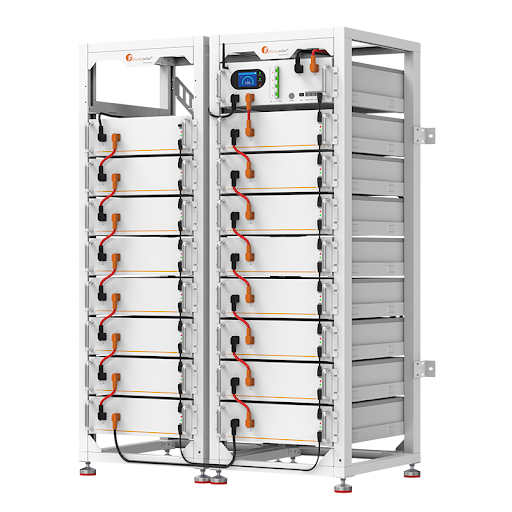

The demand for efficient energy storage is increasing as more homes, businesses, vehicles, and industrial facilities adopt renewable energy and electric technologies. Battery systems need to store significant amounts of energy while delivering power efficiently. A high voltage lithium battery can meet these requirements in applications where higher-voltage energy storage is appropriate.
High-voltage lithium battery systems use multiple cells or modules connected in series to create a higher overall voltage. This design can provide several electrical and practical benefits when properly matched with the rest of the system.
Higher Voltage and Lower Current
One of the main advantages of a high-voltage battery system is that higher voltage allows the same amount of power to be delivered with lower current.
The relationship between power, voltage, and current means that increasing voltage can reduce the current required for a particular power output. Lower current can reduce resistive losses in electrical cables and connections.
This can become particularly useful in systems that require relatively high power.
Improved System Efficiency
Reducing current can help improve the efficiency of an appropriately designed electrical system. Less energy may be lost as heat in conductors and connections.
This does not mean that every high-voltage battery system is automatically more efficient. Overall performance depends on the battery, inverter, cables, connectors, cooling system, and other components.
However, high-voltage architecture can provide useful efficiency benefits when all system components are properly matched.
Applications in Solar Energy
Solar energy storage is an important application for high-voltage lithium batteries.
During the day, solar panels can generate electricity for immediate consumption while excess energy is stored in a battery. The stored energy can then be used during the evening or when solar production is reduced.
High-voltage batteries can be paired with compatible hybrid or off-grid inverters to create energy storage systems for homes, commercial buildings, and other facilities.
Before installation, users must verify that the battery voltage range and communication system are compatible with the selected inverter.
Support for High-Power Applications
Some applications require substantial power in a relatively short period. High-voltage battery systems can be suitable for these environments because the higher voltage can help limit the current needed to deliver power.
Electric vehicles are a well-known example. Their battery systems need to supply power to electric motors while operating within practical weight and packaging constraints.
Industrial energy storage and backup power systems can also use high-voltage battery architectures when their electrical requirements justify the design.
Battery Management
A sophisticated battery management system is essential for high-voltage lithium batteries.
The BMS monitors important operating parameters such as cell voltage, temperature, current, and state of charge. It can help maintain cells within their specified operating limits.
Cell balancing can also help keep individual cells at appropriate voltage levels. This is important because the performance of a battery pack depends on the coordinated operation of its cells and modules.
Compact System Design
Higher voltage can sometimes allow designers to reduce the current carried by cables and electrical components. Depending on the application, this can contribute to a more practical system layout.
However, the physical size of the battery itself still depends on factors such as energy capacity, cell chemistry, packaging, thermal management, and mechanical design.
Therefore, buyers should evaluate the complete system rather than assuming that higher voltage always means a smaller battery.
Longer-Term Energy Storage
Lithium battery systems are commonly selected for applications requiring frequent charging and discharging. Their suitability depends on the specific lithium chemistry and system design.
For solar energy storage, users may cycle the battery regularly as part of daily energy management. A properly designed system can help users make better use of renewable electricity.
Battery lifespan depends on many factors, including depth of discharge, temperature, charging practices, operating current, and cell chemistry.
Safety Considerations
High-voltage battery systems require careful handling and professional installation. The electrical voltage involved can present significant hazards if equipment is improperly installed or maintained.
Manufacturers typically include protection features through the BMS and other electrical components. These can help manage abnormal voltage, current, and temperature conditions.
Users should follow installation instructions and applicable electrical safety requirements. Unauthorized modifications should be avoided because they can affect both performance and safety.
Choosing the Right Battery
When selecting a high-voltage lithium battery, buyers should compare several technical specifications.
Voltage: Make sure the battery is compatible with the inverter or electrical system.
Capacity: Determine how much energy needs to be stored, usually measured in kWh.
Power: Check how much continuous and peak power the battery can provide.
Cycle life: Review the manufacturer’s specified cycle-life conditions and testing methodology.
Temperature range: Ensure the battery is suitable for the installation environment.
Communication: Check compatibility with the inverter and energy management system.
Warranty: Review coverage, operating conditions, and service requirements.
Maintenance and Monitoring
Modern battery systems often provide monitoring through displays, communication interfaces, or software platforms. Monitoring can provide information about battery state of charge, energy flow, temperatures, and system alerts.
Regular monitoring can help users identify unusual behavior and arrange maintenance when necessary.
The battery should also be kept in an environment that meets the manufacturer’s requirements for temperature, humidity, ventilation, and physical protection.
Conclusion
A high voltage lithium battery can offer useful advantages for energy storage systems that require efficient delivery of significant amounts of power. Higher voltage can reduce current requirements for a given power level, potentially reducing electrical losses and supporting practical system designs.
These batteries can be used in applications such as solar energy storage, electric vehicles, backup power, and industrial energy systems. However, selecting the correct battery requires careful consideration of voltage, capacity, power rating, chemistry, BMS functions, temperature range, compatibility, and safety requirements.
When properly selected, installed, and maintained, high-voltage lithium battery technology can provide a flexible energy storage solution for modern electrical applications.