

Key takeaways
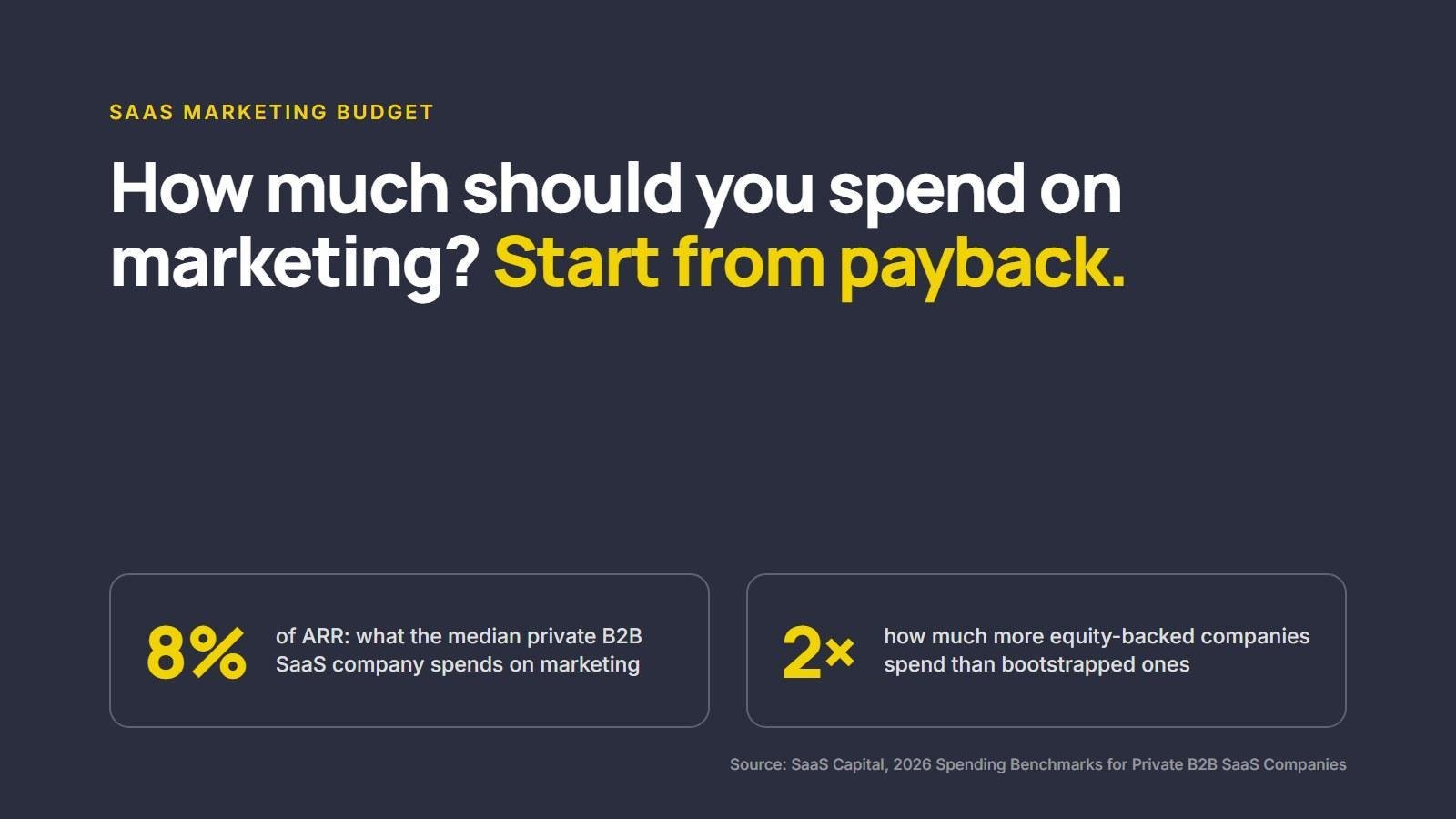
- The median private B2B SaaS company spends 8% of its annual recurring revenue (ARR) on marketing, but that average hides a twofold gap between bootstrapped and venture-backed companies.
- Copying a funded competitor’s budget can drain a bootstrapped company’s cash, even when every channel “works”.
- A budget built from payback (how many months each channel takes to earn back its cost) shows which channel deserves more money, and when to stop adding it.
- Review it monthly. A channel whose payback keeps getting longer is usually saturating.
Every SaaS founder eventually asks the same question: how much should we be spending on marketing? The usual answer is a percentage of revenue. It’s easy to quote, easy to put in a board deck, and it’s the wrong place to start.
The number everyone quotes
The figure most founders end up quoting comes from SaaS Capital’s 2026 spending benchmarks, a survey of over a thousand privately held B2B software companies. At the midpoint, marketing takes 8% of annual recurring revenue and sales takes 15%.
For a company at $2 million ARR, 8% works out at $160,000 a year, or about $13,000 a month. It sounds like a budget. The trouble starts when you look at who is behind that median.
Why the average misleads
Split the same survey by funding and the picture changes:
| What the survey measured | Self-funded companies | Investor-funded companies |
|---|---|---|
| Marketing budget | The reference point | Roughly double |
| Sales budget | The reference point | Up by about 70% |
| Typical spend across the whole company | 96% of revenue | 101% of revenue |
| Share at or near breakeven (within 2 points) | 83% | 52% |
| Typical yearly growth | 20% | 25% |
So the investor-funded group puts roughly double into marketing, buys about five extra points of growth with it, and nearly one in two of those companies is losing money along the way. That’s by design. They invest before the revenue arrives and can wait a long time for it, because fresh investment fills the hole in the meantime.
A bootstrapped company has no next round. Every dollar it spends on winning customers has to come back from those customers before it can be spent again. So a single percentage is really an average of two different strategies, and copying it means copying a strategy you may not be able to fund.
What copying the wrong company costs
Picture a bootstrapped company at $2 million ARR that benchmarks itself against a venture-backed competitor and decides to spend 16% of ARR on marketing: $320,000 a year instead of $160,000.
If its channels pay back in 18 months, every new customer ties up a year and a half of their gross profit before they’re “free”. Double the spend and you roughly double the cash locked up in customers who haven’t paid you back yet. Revenue grows, the dashboard looks great, and the bank balance goes the other way. Many founders only notice when the cash runs low, because nothing on the growth chart warns them.
The fix isn’t to spend less by default. It’s to let the economics of each channel decide.
Build the budget from payback
Payback measures how long it takes for the gross profit from a new customer to cover the cost of acquiring them:
Payback (months) = customer acquisition cost ÷ monthly gross profit per customer
To set a budget from it:
- Work out the true cost of each channel. Not just ad spend: add the software it runs on, outside help such as agencies or freelancers, and the salary cost of the hours your people put in. The founder’s hours count as well.
- Count the paying customers each channel brought in. Sign-ups and trials don’t count. Pick one attribution rule (first touch is the simplest) and keep it.
- Calculate payback per channel. One blended figure hides the channel that’s losing money.
- Set a payback limit you can afford. Many bootstrapped companies aim for under 12 months. Funded companies can go longer if investors know and the cash covers it.
- Fund channels in order of payback, adding budget in steps, until a channel’s payback reaches your limit.
The budget is whatever comes out of step 5. It might be above or below 8% of ARR. What matters is that every channel in it earns its money back within your limit.
A worked example
Take the same $2 million ARR bootstrapped company. Its average subscription is $500 a month, and after hosting and support it keeps 80% of that, so every new account brings in $400 of gross profit a month. The founders set a 12-month payback limit, which means they can afford to spend up to $4,800 to win a customer.
Here’s the last quarter, as a monthly average:
| Channel | True monthly cost | New customers a month | CAC | Payback |
|---|---|---|---|---|
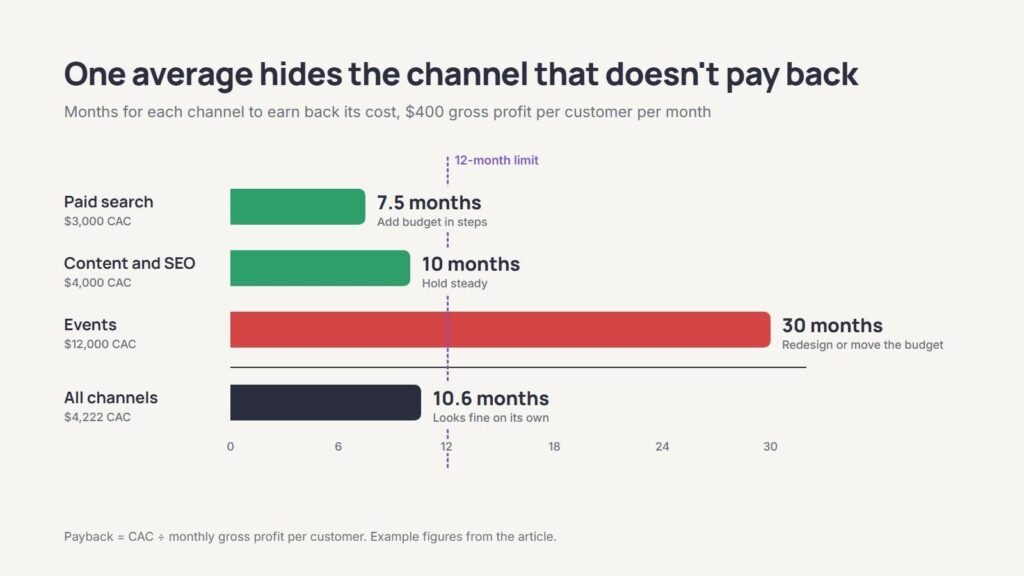
| Paid search | $9,000 | 3 | $3,000 | 7.5 months |
| Content and SEO | $4,000 | 1 | $4,000 | 10 months |
| Events | $6,000 | 0.5 | $12,000 | 30 months |
| All channels | $19,000 | 4.5 | $4,222 | 10.6 months |
The blended figure, 10.6 months, is inside the limit. On its own it says everything is fine. Per channel, it isn’t:
- Paid search pays back in 7.5 months. It’s the place to add budget, in steps of 10 to 20%, rechecking payback each month, because the cheapest customers come first and the cost per customer rises as you scale.
- Content and SEO pays back in 10 months and usually gets cheaper over time, because articles keep bringing in customers long after they’re paid for. Hold it steady.
- Events take 30 months. That’s two and a half years of tied-up cash per customer. Either redesign the approach (smaller, targeted events with follow-up meetings booked in advance) or move most of that $6,000 into paid search and a small test of a new channel.
The total, $19,000 a month or $228,000 a year, is about 11% of ARR, well above the 8% median. For this company that’s fine: almost all of it pays back within a year. A company spending exactly 8% on channels that take two years would be in a worse position.
What belongs in the budget
Founders tend to undercount. A complete marketing budget includes:
- media and ad spend;
- software (CRM, analytics, email, landing pages, data);
- agencies, freelancers and contractors;
- salaries, or the share of them spent on marketing, including the founder’s;
- content production: writing, design, video;
- events, sponsorships and travel;
- a small, named budget for trying new channels, where every trial has an end date and a keep-or-drop decision.
Leaving any of these out flatters the payback figure, which is how budgets drift into channels that don’t pay their way.
Review it every month
A payback budget isn’t set once a year. Recalculate each channel monthly with the same rules. Watch for three signals:
- Payback getting longer as you add spend: the channel is saturating. Stop adding.
- Payback getting shorter without extra spend: something is compounding (often content, referrals or word of mouth). Protect it.
- A test channel past its decision date: keep it or close it. Don’t let it become a permanent line by default.
The percentage benchmark still has a use: as a sanity check, not a target. If you’re far above it, make sure the payback justifies it. If you’re far below and your channels pay back quickly, you’re probably leaving growth on the table. There’s a fuller breakdown of how bootstrapped and VC-backed SaaS companies set their marketing budgets if you want to compare your numbers with both groups.
Start with the channels you have, work out what each one really costs, and let the payback numbers tell you which one earns the next increase.
Lucy Tsotsorina works with B2B SaaS founders as a fractional and interim CMO through CMO4SaaS. Over 18 years in B2B marketing, more than 10 of them leading teams, and an Executive MBA from IE Business School have left her with one question she asks of every budget: what pays back?