
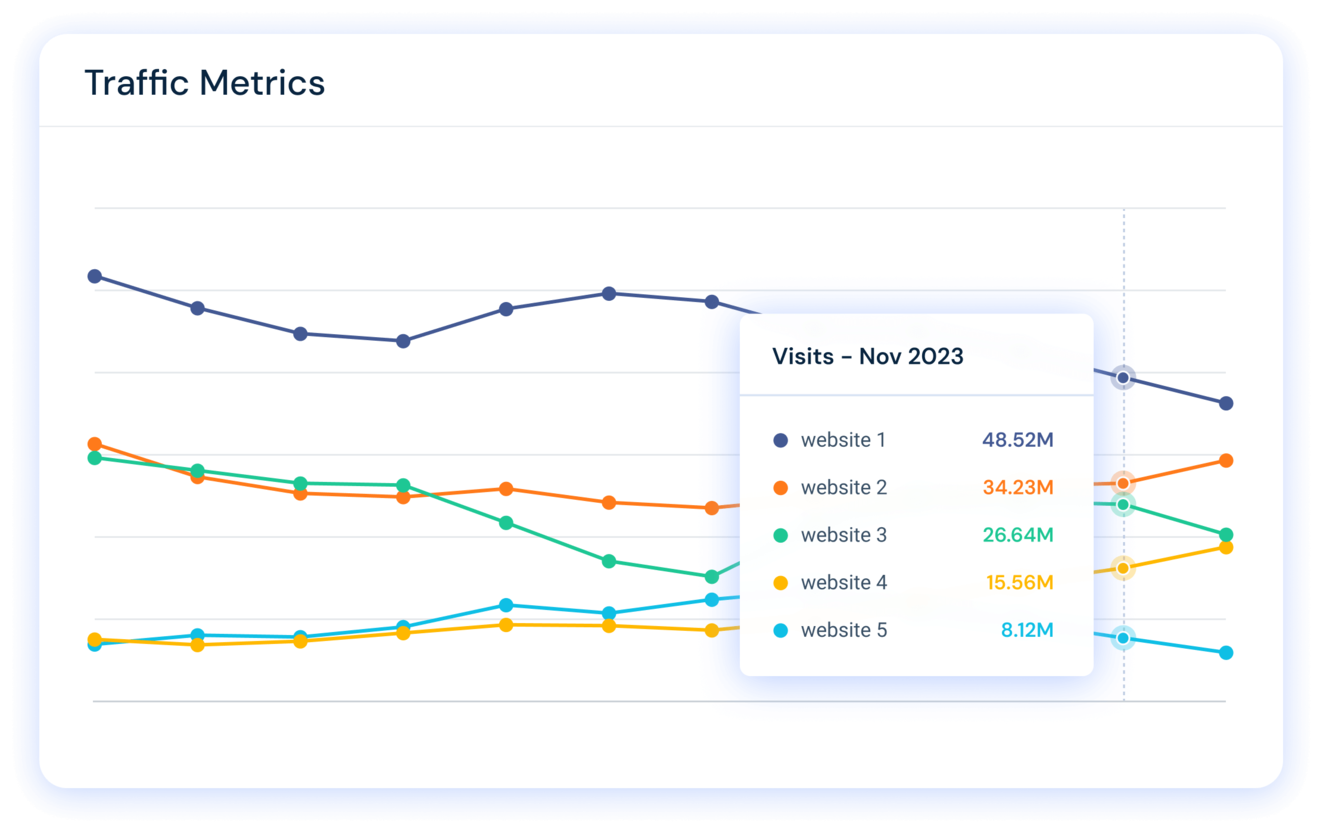

When you assess a finance website for a guest article, partnership, or advertising campaign, its traffic estimate can look like the clearest measure of reach. It is only an estimate, though, and different analytics tools may report very different numbers for the same domain. Knowing how to compare traffic estimates for finance websites means looking beyond a single monthly-visit figure and checking whether the audience, geography, and trend suit your goal.
A site with a smaller but highly relevant readership may be more useful than a large publication whose visitors rarely engage with your subject. Traffic data is best treated as one part of a decision, alongside editorial quality, audience fit, and the terms of publication.
Understand what the number represents
First, check what each tool calls “traffic.” Some estimate visits or sessions; others may report unique visitors, page views, or search visits. These are not interchangeable. A monthly visit estimate is also not the same as a site’s verified analytics, which only its owner can provide.
Third-party platforms use their own data sources and models. A domain may therefore have one estimate in one service and a substantially different figure elsewhere. Rather than deciding that one source must be correct, use estimates as directional evidence. A consistent pattern across several checks is generally more informative than a precise-looking number from a single tool.
Make comparisons like for like
Before comparing two finance sites, confirm that you are viewing the same time period, country, and traffic metric. A global estimate can obscure the fact that most visitors come from a market your business does not serve. Likewise, a site with a large monthly audience may get little of its traffic from search, while another has a smaller but steadily growing organic audience.
Look at several months rather than a single snapshot. Seasonal reporting, market events, and changes to a publication’s content can cause short-term spikes or dips. A sustained rise or decline may be more meaningful, but it still needs context: a major news story can temporarily attract visitors without changing the site’s long-term audience.
- Geography: Compare the share of visitors in the countries or regions that matter to your campaign.
- Traffic sources: Review the estimated balance of search, direct, referral, and social visits.
- Trend: Check whether traffic is stable, growing, or falling over a useful period.
- Page-level fit: Find out whether the site has content in the finance topic you plan to address.
Look for the right finance audience
“Finance” covers a wide range of interests. A publication focused on market data may reach a different audience from one covering financial technology, small-business operations, or cryptocurrency. Consider who reads the site and what they are likely to do with the information. A guest article for business owners should ideally appear where those readers already seek practical advice, not simply on a site with a finance label.
Review recent articles, publishing frequency, author details, and the way the publication handles outside contributions. Do its stories show subject knowledge? Are headlines and claims supported by clear information? Does the site attract meaningful discussion or referral attention? These observations will not prove a traffic estimate, but they help establish whether the potential audience is real and relevant.
It is also useful to separate audience fit from domain authority scores. Metrics can help shortlist publications, but they do not tell you whether a particular page will interest your intended readers. A practical discussion of finance guest-posting relevance and authority can help frame that comparison: assess the publication’s topic, audience, and publishing terms as well as its headline metrics.
Check the estimate against other signals
Use more than one traffic-estimation platform where possible, and record the results with the date you checked them. If estimates vary widely, note the range instead of averaging them into a figure that appears more certain than it is. You can also compare rankings and visibility for relevant search topics, the number and freshness of finance articles, and whether other credible sites refer readers to the publication.
When a placement is under consideration, ask the publisher for information that can clarify the picture, such as audience location, typical referral performance, or the expected placement and duration of the article. Not every publisher will share private analytics, so treat any figures they do provide in context. Avoid making a forecast based only on total domain traffic: the article’s position, subject, promotion, and lifespan all affect the visits it may receive.
Include the cost and workload
A useful comparison weighs likely audience value against the complete cost, not just a traffic score. Include the fee, content preparation, editing time, and any conditions attached to publication. If your team is small, routine financial administration can also take time away from evaluating opportunities. Some businesses use a virtual assistant for bookkeeping to organize records and recurring tasks; Osdire’s hiring guide explains factors such as provider type and rates to consider when planning that support.
Keep a simple comparison sheet with the site, audience focus, estimated traffic range, geographic fit, trend, publication terms, and total cost. Add a note about why the site is a match. This makes it easier to explain a decision and to review later whether the placement brought relevant visits, inquiries, or other results.
Choose for fit, not just scale
Traffic estimates are useful for screening finance websites, but they are not guarantees of readership or campaign results. Compare consistent metrics, look for stable patterns, and validate the figures with editorial and audience signals. The strongest opportunity is usually the one that reaches the right people under clear terms at a reasonable cost—not automatically the site with the largest estimated number.