
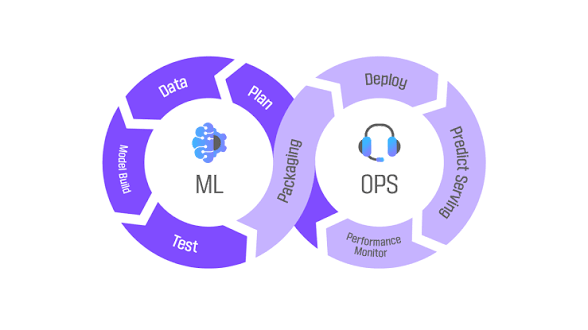

Setting an ML model is only half the job; the other half—ensuring that it is deployed reliably, keeping a close watch on its behaviour, and maintaining its accuracy over time—is something that many teams find difficult. A model which performs well in a controlled testing environment can quickly fail to remain effective when it is used in real-world data that changes and evolves.
The reason that led to the development of Machine Learning Operations—more commonly referred to as MLOps—is this: by applying engineering principles to the machine learning lifecycle, MLOps ensures that models are transferred in a standard manner from the development stage to production and that they are then maintained in that state. For anyone studying data science classes in Pune or taking part in any kind of structured training programme, it is no longer optional to understand MLOps; it has now become a basic necessity for those who want to build AI systems that work in real-world situations.
What is MLOps and why does it matter?
MLOps is a collection of practices which combine machine learning, software engineering, and DevOps principles with the aim of aiding the deployment and the ongoing management of machine learning models; it addresses one of the most persistent problems in applied AI, namely the gap between building a model and running it reliably at scale.
Without MLOps, teams often face:
- Inconsistent deployment processes that introduce errors or version conflicts
- No visibility into how a model is performing after launch
- Manual retraining cycles that are slow, undocumented, and error-prone
- Model drift, where a model’s predictions become less accurate as the real-world data it receives changes over time
This last point should be given special consideration. Model drift occurs when the statistical characteristics of the input data move away from those on which the model was trained. For instance, a fraud detection model that was trained on transaction patterns from 2022 might carry out poorly when facing fraud techniques in 2025. Failure to monitor generally means that this decline is not picked up until it results in observable business failures.
Understanding Model Drift: Types and Causes
Model drift is not a single phenomenon; it takes on different forms and each of these forms requires a different kind of response.
Data drift occurs when there is a change in the distribution of the input features; for instance, if a retail demand forecasting model had been trained on purchasing behaviour before the pandemic, the alteration in buying patterns after the pandemic would make the inputs look very different from those in the training data.
Concept drift occurs when the relationship between the inputs and the outputs changes, even if the inputs themselves remain similar. For instance, a credit scoring model might find that the same financial profile now shows a different level of default risk as a result of changes in economic conditions.
Label drift happens when there is a change in the distribution of the target variables with time, a phenomenon which is particularly common in classification problems because of the varying proportions of the classes.
To work out what kind of drift is taking place it is necessary to carry out continuous monitoring — a capability which MLOps frameworks are designed to offer. Increasingly, the courses in Pune that provide data science classes are including drift detection and monitoring as part of their practical machine learning curriculum, this showing how important this knowledge has become.
Key Components of a Mature MLOps Pipeline
A well-structured MLOps pipeline includes the full model lifecycle, from data ingestion to post-deployment monitoring, and the following components are usual in production-grade systems.
The use of version control for both data and models ensures that all experiments can be reproduced. For instance, tools such as DVC (Data Version Control) maintain records of the changes made to the datasets together with the code, and model registries such as MLflow store the different versions of the trained models together with their associated metadata.
Automated training pipelines take the place of manual retraining by using workflows that are either scheduled or set up to be triggered. If drift is detected or new data becomes available, the pipeline is able to automatically retrain the model, assess it against the specified performance criteria, and promote it to production if it meets these criteria.
Continuous monitoring allows the model’s performance to be tracked in real time, with metrics including prediction confidence, the distributions of the input features, and output accuracy being recorded and compared to baseline values. Alerts are set off when deviations go beyond the acceptable limits.
CI/CD (Continuous Integration and Continuous Deployment) refers to the application of software development best practices to machine learning workflows. Automated testing is carried out before any changes to the model code or configuration are deployed, thereby reducing the risk of regressions being introduced.
Platforms like Kubeflow, MLflow, and AWS SageMaker Pipelines offer the necessary infrastructure for implementing these components, and it is now increasingly expected that working data scientists should be familiar with at least one of them.
Conclusion
It is MLOps that distinguishes experimental machine learning from AI which is ready for use in production. It does this by establishing standards for how models are deployed, monitored, and maintained, thus tackling the problem of model drift and the operational deficiencies which cause AI systems to fail without being noticed in the real world.
For anyone studying data science in Pune, it is just as important to become fluent in MLOps concepts as it is to become proficient in algorithms, since employers in all fields want people who are able to deploy a model and keep it performing accurately over time, this being what distinguishes a practitioner who can deliver continuous value from one who can only produce prototypes.