
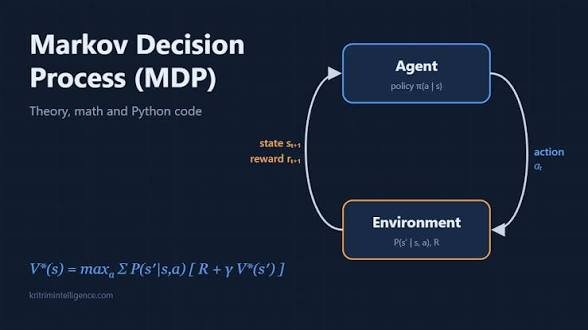

Many real-world decisions are not one-off choices. They unfold over time, with each action changing what happens next. A delivery robot chooses a route, reaches a junction, sees new obstacles, and chooses again. A pricing system updates a discount, sees how customers respond, and adjusts further. These situations share two traits: uncertainty (you cannot predict outcomes perfectly) and sequential dependency (today’s choice affects tomorrow’s options). Markov Decision Processes (MDPs) provide a clean mathematical framework for modelling and solving exactly these problems, and they sit at the heart of modern reinforcement learning.
If you are exploring these ideas through an artificial intelligence course in Mumbai, understanding MDPs is one of the fastest ways to connect theory (probability, optimisation) with practical AI systems (recommendation, robotics, operations).
What Exactly Is an MDP?
An MDP formalises a decision-making problem using a small set of building blocks:
- States (S): A state is a snapshot of the environment at a point in time. For a robot, it could be its location and battery level. For a customer system, it could be a user’s recent activity and current offer.
- Actions (A): Actions are the choices available to the agent in a given state—turn left, recharge, offer a discount, ship from warehouse A, and so on.
- Transition probabilities (P): This captures uncertainty. After taking an action in a state, the environment moves to a new state according to a probability distribution.
- Rewards (R): A reward is a numerical signal that represents immediate desirability—profit, speed, accuracy, safety, or a combination.
- Discount factor (γ): This balances short-term and long-term rewards. A value close to 1 makes the agent care more about the future; lower values prioritise immediate outcomes.
The “Markov” part refers to the Markov property: the future depends on the present state (and action), not on the full history. In practice, you design the state so it contains enough information to make this a reasonable assumption.
Policies: Turning the Model into a Strategy
An MDP becomes useful when we define a policy (π)—a rule that tells the agent what action to take in each state. Policies can be:
- Deterministic: always choose the same action for a given state.
- Stochastic: choose actions with certain probabilities (useful when exploration or risk management matters).
To evaluate a policy, we use value functions:
- State-value function V(s): expected long-term return starting from state s and following policy π.
- Action-value function Q(s, a): expected long-term return starting from state s, taking action a, then following π.
These functions are tied together by the Bellman equations, which express the idea that “the value of today equals today’s reward plus the expected value of tomorrow.” This recursive structure is what makes MDPs computationally solvable.
How Do We Solve MDPs?
There are two broad scenarios: you either know the environment dynamics (transition probabilities and rewards) or you do not.
When the model is known: Dynamic Programming
If P and R are known, classic methods include:
- Value Iteration: repeatedly updates V(s) using Bellman optimality until it stabilises.
- Policy Iteration: alternates between evaluating a policy and improving it.
These methods are powerful but can become expensive when the state space is large.
When the model is unknown: Reinforcement Learning
In many real systems, you cannot write down exact transition probabilities. Instead, the agent learns from interaction:
- Q-learning: learns Q(s, a) directly from experience, aiming for the optimal policy.
- SARSA: learns in an on-policy manner (updates based on the actions actually taken).
- Deep RL: uses neural networks to approximate value functions when state spaces are huge (images, text signals, complex user behaviour).
For learners coming from an artificial intelligence course in Mumbai, this is often the “aha” moment: MDPs are the theoretical backbone, while reinforcement learning provides the learning mechanism when the world is too complex to model precisely.
Where MDPs Show Up in Real Life
MDPs are not limited to robotics labs. Common applications include:
- Robotics and navigation: choosing movements under uncertainty (slippery surfaces, sensor noise).
- Inventory and supply chain: deciding reorder quantities with uncertain demand.
- Online advertising and bidding: selecting bids based on conversion probability and budget constraints.
- Healthcare decision support: selecting treatment actions while balancing outcomes and side effects over time.
- Customer retention systems: choosing interventions (messages, offers) to maximise long-term engagement rather than short-term clicks.
In each case, the strength of MDPs is that they force clarity: What is the state? What choices exist? What uncertainty matters? What does “good” mean in numbers?
Modelling Tips and Common Pitfalls
- State design matters more than algorithms. If the state leaves out critical context, the Markov property breaks and learning becomes unstable.
- Reward shaping must be done carefully. Poorly designed rewards can produce “clever” but undesirable behaviour (optimising the metric while harming the goal).
- Watch out for huge state spaces. Realistic problems can explode in size; function approximation and simplification become necessary.
- Validate with offline tests first. In business settings, unsafe exploration can be costly—use historical data, simulators, and controlled rollouts.
Conclusion
Markov Decision Processes provide a rigorous, practical way to model sequential decision-making under uncertainty. By defining states, actions, transitions, rewards, and a discount factor, MDPs turn messy real-world problems into solvable optimisation tasks. Whether you solve them with dynamic programming (when the model is known) or reinforcement learning (when it is not), the core idea stays the same: learn a policy that maximises long-term value.
If you are building your foundations through an artificial intelligence course in Mumbai, investing time in MDPs will pay off across multiple AI domains—especially reinforcement learning, optimisation, and decision intelligence.