
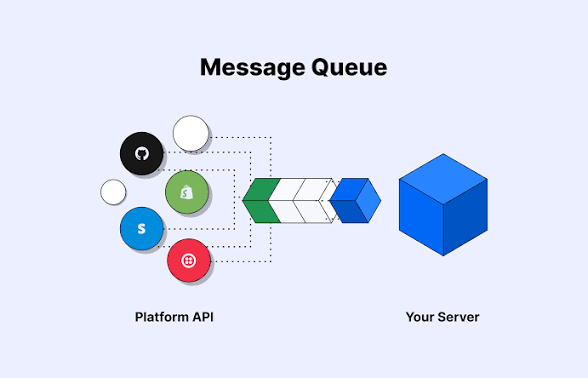

Every production application reaches a point where incoming requests outpace the system’s ability to process them. An e-commerce platform receives thousands of orders during a flash sale. A logistics application ingests GPS updates from hundreds of vehicles every second. In each of these situations, a system that processes requests synchronously under peak load will either slow down significantly or fail entirely.
Message queue throttling solves this problem. By placing an asynchronous buffer between the data source and the components that process it, teams can absorb sudden traffic spikes, regulate the processing rate, and maintain system stability without overprovisioning infrastructure. Understanding this concept is increasingly relevant for developers working on distributed systems, and it forms a core topic in any quality full stack developer course in Coimbatore that covers backend architecture.
What Is a Message Queue and How Does Throttling Work?
A message queue is a component that accepts messages from producers and holds them until consumers are ready to process them. The producer and consumer operate independently. The producer does not wait for the consumer to finish before continuing its work, and the consumer processes messages at its own pace without being overwhelmed by the rate at which they arrive.
Throttling is the mechanism that controls how many messages a consumer processes within a given time window. Instead of allowing a consumer to pull an unlimited number of messages at once, throttling sets a defined rate, such as 500 messages per second or 100 messages per worker thread per minute. This keeps the consumer within its safe operating capacity and prevents resource exhaustion.
Without throttling, a consumer that pulls messages as fast as possible during a spike can exhaust memory, saturate database connections, or trigger cascading failures in downstream services. Throttling acts as a regulatory layer that protects the entire processing chain.
Asynchronous Buffer Systems in Practice
The most widely used message queue platforms include RabbitMQ, Apache Kafka, and Amazon SQS. Each implementation of the buffer concept differs but shares the same underlying principle: producers write to the queue, and consumers read from it at a controlled rate.
In RabbitMQ, throttling is commonly implemented using the prefetch count setting. This tells the broker how many unacknowledged messages a single consumer can hold at one time. Setting a prefetch count of 10, for example, means the consumer processes 10 messages before fetching more. This prevents a single consumer from pulling the entire queue into memory at once.
In Kafka, throttling is managed through consumer group configurations and poll settings. Developers set the maximum number of records fetched per poll cycle and control consumers’ pause-and-resume behaviour by calling the pause method on the consumer instance. Kafka also supports producer-side throttling through quota configurations that limit the data rate per client.
Amazon SQS pairs naturally with AWS Lambda for serverless throttling. Lambda’s concurrency limits act as a natural throttle on how many queue messages are processed simultaneously. When the concurrency limit is reached, SQS holds additional messages until capacity becomes available.
Beyond the queue platform itself, developers implement application-level throttling using rate limiter libraries such as Guava RateLimiter in Java or Bottleneck in Node.js. These libraries give fine-grained control over processing rates within the consumer application itself.
Designing a Throttled Queue System Effectively
A well-designed throttled queue system requires decisions about more than just the rate limit. Teams need to define how messages are prioritised when the queue grows large, how long a message can remain in the queue before it is considered stale, and what happens to messages that repeatedly fail processing.
Dead-letter queues address failure scenarios. When a message fails to process beyond a set retry limit, it is moved to a separate dead-letter queue for inspection and reprocessing without blocking the main queue. This keeps the primary data flow clean and provides visibility into problematic messages.
Monitoring is equally important. Queue depth, consumer lag, and processing latency should all be tracked in real time. A queue that grows consistently signals that the consumer rate is too low relative to the producer rate and that capacity adjustments are needed. Covering these design decisions in depth is a key strength of a practical full stack developer course in Coimbatore that addresses real-world backend engineering challenges.
Conclusion
Message queue throttling is a foundational technique for building systems that handle high data volumes without degrading under pressure. By introducing an asynchronous buffer between producers and consumers and regulating the processing rate, development teams protect their infrastructure, improve reliability, and create headroom for traffic growth. Understanding how to configure, monitor, and optimise these systems is a skill that applies directly to production-grade applications across every industry.