
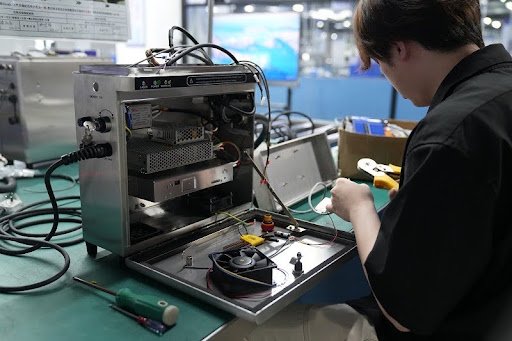

Metal manufacturers often need to identify components with serial numbers, product codes, logos, and traceability information. A portable fiber laser marking machine offers a flexible way to create these marks on suitable metal surfaces, including parts that are too large or heavy to move to a fixed workstation.
Fiber laser marking is valued for its precision, repeatability, and ability to produce marks without conventional ink or labels. Portable designs make the technology useful in fabrication shops, industrial maintenance facilities, and manufacturing environments.
Understanding material compatibility and marking requirements is essential for obtaining reliable results.
Why Fiber Lasers Are Used for Metal Marking
Fiber lasers deliver concentrated optical energy to a selected surface. The material responds to that energy, producing a mark through controlled changes such as surface oxidation, discoloration, or material removal.
The exact result depends on the metal, surface treatment, laser settings, and marking method. A suitable process can produce fine text, logos, serial numbers, and machine-readable codes.
Fiber laser systems are commonly used for metal marking because they can deliver precise results on many industrial metals. However, the appropriate settings for stainless steel may differ from those required for aluminum or brass.
Testing is essential before introducing a new material or marking method into production.
Metals Commonly Marked With Fiber Lasers
Stainless Steel
Stainless steel is widely used in industrial equipment, kitchen products, tools, and medical-related hardware. Fiber lasers can create identification marks and selected contrasting finishes on suitable stainless steel grades.
The final appearance depends on the grade, surface finish, and selected process. Where specific corrosion resistance or regulated marking requirements apply, the result should be validated against the relevant specifications.
Carbon Steel
Carbon steel components can be marked with part numbers, logos, and production identifiers. Depending on the process, the mark may involve surface alteration or material removal.
If the component has a coating, the operator should determine whether the coating is intended to be marked or removed. Processing coatings may produce fumes that require suitable extraction.
Aluminum
Aluminum is commonly used for housings, panels, industrial parts, and identification plates. Fiber laser settings must account for the alloy, surface finish, and any anodized or painted layer.
Testing helps determine whether the desired contrast can be achieved without damaging the component.
Brass and Copper Alloys
Brass and certain copper alloys can be marked using suitable fiber laser systems. Their reflective properties and thermal behavior may affect process settings.
Confirm the machine manufacturer’s guidance before processing highly reflective materials, and use the specified safety measures to control reflected laser energy.
Benefits of Portable Metal Marking
Mark Large Components in Place
Large machinery, frames, fabricated structures, and industrial housings can be difficult to move. A portable fiber laser marking machine can reduce the need to transport these items to a fixed marking station.
This can simplify workflows when the machine head can be positioned safely and accurately.
Improve Identification
Permanent markings help workers identify components during assembly, inspection, maintenance, and shipment. Serial numbers and product codes can also support warranty records and inventory systems.
For traceability to work effectively, the marked information must remain readable and be connected to accurate digital records.
Reduce Label Dependence
Labels may peel, fade, or become detached under certain conditions. Laser marking creates the identifier directly on a suitable surface, reducing dependence on a separate label.
Its durability still depends on marking depth, surface condition, abrasion, chemicals, and environmental exposure.
Support Small and Detailed Markings
Fiber lasers can produce compact text, logos, and codes when the machine and material are appropriately configured. This is useful for components with limited marking space.
Small codes should be verified using the scanners and inspection methods intended for actual use.
Choosing the Correct Marking Method
Not every marking application requires the same depth or appearance.
Surface marking may be appropriate for product identification where a clear contrast is sufficient. Deeper engraving may be needed when the mark must withstand more demanding mechanical wear.
A process intended to remove material can affect surface finish and dimensional tolerances. This is particularly important for precision components or parts with strict manufacturing specifications.
Before choosing a process, define the required mark depth, contrast, size, durability, and production time. A supplier can then recommend a suitable machine configuration and provide sample results.
Important Machine Specifications
Laser Power and Pulse Characteristics
Laser power influences available processing capability, but it is not the only factor determining the quality of a mark. Pulse characteristics, scanning speed, focus, and software settings also matter.
Ask for demonstrations on the actual metal grade rather than relying only on a specification sheet.
Marking Area
The marking field determines the size of the design that can be processed in one setup. For large parts, the operator may need to reposition the head or use an appropriate marking arrangement.
Head Design and Handling
The head should be comfortable to position and suitable for the shape of the component. Cable routing and controller placement should not interfere with the operator or the workpiece.
Software and Identification Codes
Check whether the software supports logos, serial numbering, text, barcodes, and QR codes. If codes change for every component, efficient data entry or automated numbering can save time.
Integrating Laser Marking Into Production
A portable fiber laser marking machine can be used at several stages of production, including fabrication, assembly, inspection, and final identification.
Standardized templates help operators apply consistent text sizes and layouts. Written procedures can define component positioning, approved settings, inspection steps, and recordkeeping.
For batch work, sample parts should be checked before the entire order is marked. This reduces the risk of applying incorrect information to multiple components.
Businesses should also consider how marked identifiers connect with their inventory or quality management systems. A permanent code is most useful when it links to reliable product information.
Safety for Metal Marking
Laser radiation can cause serious eye injuries, and reflective metal surfaces can redirect energy unexpectedly. Operators must follow the machine’s safety instructions and the applicable laser safety requirements.
Use the specified protective eyewear and engineering controls. Depending on the system and application, an enclosed work area, interlocks, access restrictions, and warning indicators may be necessary.
Marking painted, coated, or treated metals may release airborne contaminants. Select extraction and ventilation based on the material and the process.
Never operate the machine with safety features disabled or allow untrained people to access the marking area.
Maintenance and Operating Costs
Routine care may include inspecting cables, keeping the marking head clean, checking connections, and following the manufacturer’s optical maintenance procedures.
Operating costs include electricity, maintenance, safety equipment, extraction, and any replacement components. Although laser marking typically avoids ink and ribbon expenses, it is not cost-free.
Compare these costs with current labor, labeling, and handling expenses. The financial benefit will depend on how frequently the machine is used and how much time it saves.
Frequently Asked Questions
Can a portable fiber laser marking machine mark all metals?
It can mark many common metals, but results vary by alloy, finish, coating, and machine specifications. Always test the intended material first.
Is laser marking permanent on metal?
Marks can be highly durable, but performance depends on marking depth, material, and exposure to abrasion or chemicals.
Can portable laser equipment mark large steel parts?
Yes, provided the head can be positioned safely within the machine’s specified working range and the marking area is suitable.
Does metal laser marking require consumables?
It generally does not require ink or printing ribbons, but it still involves electricity, maintenance, safety equipment, and possible extraction costs.
Conclusion
A portable fiber laser marking machine provides a flexible method for identifying metal components with text, logos, serial numbers, and traceability codes. It can be especially useful when large or heavy workpieces cannot easily be moved to a fixed marking station.
Choose equipment based on the actual metal grade, desired mark, production volume, software needs, and safety requirements. Testing representative samples before purchase helps establish whether the system can deliver the required quality and consistency.