
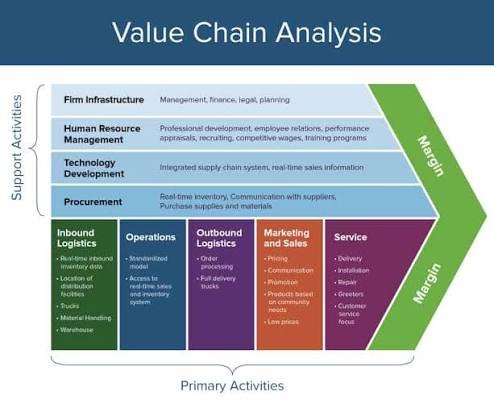

Every business has a set of steps to get its product or service to the customer. These steps, from sourcing the raw materials right through to after sales support, can either add value or consume resources. Value chain optimisation is all about examining those steps to identify the waste, to reduce the waste and to improve the elements that actually create value for the business.
Michael Porter introduced the value chain in 1985 as a way of thinking about how value is created at each stage of the operation of a business. It’s now a very widely used concept with businesses across a wide range of industries applying it in order to improve performance, reduce cost and achieve a sustainable competitive advantage.
Understanding the Value Chain Framework
A value chain has two parts: the primary activities and the support activities.
Primary activities are the actual steps in the process of making and delivering the product. These are the activities of getting the materials in and storing them, turning the materials into the finished product, delivering the product to the customer, marketing and selling the product and after sales service.
Support activities help the primary activities to work better. These are things like purchasing, R&D, human resources and the like, and the maintenance of the infrastructure of the business.
Optimising the value chain is about looking at each element and asking where value is added, where it’s lost and where it can be improved. It’s not simply about cutting costs, it’s about increasing the gap between what the customer gets and what it costs to deliver it.
Key Steps in Value Chain Optimisation
1. Map All Activities
Start by listing every activity in your business (both what happens in house and your work with your suppliers and distributors). That way you can identify the repetitive tasks, the bottlenecks and the points where errors are likely to occur.
2. Analyse Costs and Value at Each Stage
Once you’ve mapped the activities, work out the cost of each and the value it adds. That tells you which activities are actually making money and which are just consuming resources without delivering any real value. One example might be a company realising that its delivery cost is significantly above the industry average and that therefore there is a real opportunity to renegotiate or indeed change the way it delivers.
3. Benchmark Against Competitors
Compare your value chain against that of your competitors to see where they are more efficient or providing more value. Benchmarking will help you set realistic targets for improvement and will tell you what your customers actually care about.
4. Use Data to Drive Decisions
Value chain optimisation today is very much data driven. You’ve got analytics tools being used to track performance, forecast demand, monitor supplier performance and identify trends in customer behaviour. The people who can actually use the data are the ones who are in demand. A business analytics course in Bangalore is a very sensible thing for a professional in the Indian tech capital to do if they want to develop these skills and make better value chain decisions.
Technology’s Role in Value Chain Efficiency
Digital tools have transformed the way companies go about improving their value chains. ERP systems bring together information from across the organisation so that managers can see inventory, production and sales in one place in real time. SCM software helps companies to work more effectively with their suppliers and logistics partners, reducing the potential for delays and stockouts.
Companies are increasingly using AI and automated learning to forecast changes in demand, automate routine tasks and detect quality issues before products even reach the customer. Companies that use these technologies typically operate more efficiently, react more quickly and maintain a consistent level of quality.
For the professional, if you’re going to work in this field you need to know how to use the data platforms, the visualisation tools and the predictive techniques. A business analytics course in Bangalore would give you the hands on experience with the tools and techniques that are used to perform value chain analysis and to make intelligent business decisions. Analysis of Competitive Advantage.
Optimising a value chain is a continuous process rather than a one-off exercise. Markets are in a state of flux, customers want new things and new competitors are constantly emerging. The companies that keep on working on their value chain are the ones that are best placed to adapt without sacrificing efficiency.
A well-optimised value chain serves a business in two principal ways. It reduces cost so that either the business can offer a better price or can keep more of the profit. It also improves the quality and consistency of what the customer gets which in turn leads to greater customer loyalty and a better reputation.
Conclusion
Value chain optimisation is a very effective way of improving the way a business works. You go through each stage of the chain, you know what it costs and what it adds in terms of value, and you use the data to make decisions. The result is that you can eliminate waste and build genuine competitive advantage. It’s a very practical approach for anyone in the business world whether you’re a business leader, you’re an analyst or you’re just getting started. It’s a way of creating real value in any sector.