
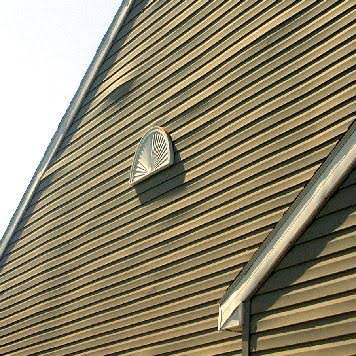

Why does vinyl siding that looked fine for a decade suddenly buckle across a whole wall? In the North Pittsburgh suburbs, the answer is rarely the vinyl itself. Panels rated for this climate handle our freeze and thaw swings without much complaint. What gives out first is what sits behind them, the moisture barrier and the way the siding was hung. That is why careful homeowners here compare siding contractors franklin park pa crews on prep work, not just on price. Get the prep wrong and even the best panels still fail early.
Warped Panels Usually Signal A Moisture Problem
Walk a buckled wall and the story is usually written in the sheathing. The case we see most often is a wavy south or west elevation over sheathing that got wet and dried out too many times, a wall on borrowed time. A straight horizontal band of warping points to panels nailed too tight, with no room left to move. Warping low on the wall points to water finding a path behind the barrier, and both problems keep coming back until the wall itself gets fixed.
What Actually Fails Behind The Siding
Vinyl sheds most water but it does not seal the wall; the layer underneath does the real waterproofing. Ten or fifteen years ago, local crews often stapled up housewrap, left the seams untaped, and nailed the panels down snug. Today the standard is a taped water resistive barrier, flashing at every window and kickout, and panels hung loose enough to expand (nobody misses the old brittle panels, trust me).
The backing matters more than most homeowners expect. In an experimental study of insulated cladding run through the Department of Energy’s technical library, researchers measured the foam layer at an added R-value of roughly 4.0 to 4.3. That is enough to blunt the thermal bridging that shows as cold stripes over the studs. On a two story colonial, you feel it at the thermostat, not just at resale.
None of that trouble is visible from the curb. It only turns up when the panels finally come off.
What A Re-Side Really Costs Here
Re-siding is a bigger check than a repair, and 2026 has not made it cheaper. The Harvard Joint Center’s remodeling index, in its April 2026 update, had homeowner improvement spending easing toward about 1.6 percent growth by year end. Budgets are tighter, and people want the number right the first time.
Run the math on a typical two story house here with about 1,800 square feet of wall. Standard vinyl installed lands around $6.50 a square foot, so panels and labor come to roughly $11,700. Tear-off and haul-away add about $1,200, and replacing failed sheathing with a taped barrier runs another $1,600. That puts the job near $14,500 all in, before trim and gutters. Skip the barrier to save that $1,600 and you are re-siding again in eight years.
Questions Homeowners Ask Us Most
Can I Just Repair The Warped Section?
Sometimes, if the damage is truly local and the barrier behind it is intact. When one panel took a hit from a ladder or a branch, a spot replacement is honest and cheap. When a whole elevation is waving, a patch only hides the wall problem for another season.
What Separates A Good Install From A Bad One?
Mostly the parts you never see. The Journal of Light Construction’s installation guidance calls for vinyl fastened with about 1/32 inch of play under each nail head, the Vinyl Siding Institute standard that lets panels move instead of buckle. Behind that spec, a torn or never-taped barrier is what turns a fresh re-side back into the same old leak.
How Long Should A New Install Last?
A correct install on quality vinyl should give you 25 to 40 years in this climate. The vinyl panels themselves rarely wear out first. The flashing, the caulk joints, and the barrier decide whether you reach the top of that range.
Getting The Install Right The First Time
New siding is only as good as the wall it hides. The homeowners still happy five winters later spent their vetting energy on prep, flashing, and the barrier, then treated panel color as the last call. When you compare siding contractors franklin park pa homeowners recommend, ask what goes on behind the vinyl and how a crew handles a wall that is already wet. That answer, more than the quote, tells you how the job will age.