
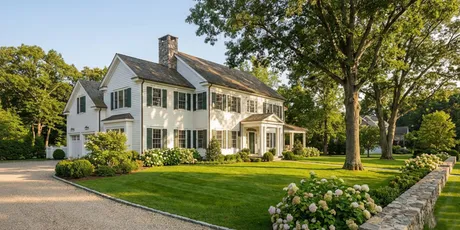

You close on an older colonial in Westport, walk the neglected half-acre out back, and the lawn tells you everything the listing photos left out. Thin turf under the oaks, crabgrass filling the sunny stretch, moss creeping across the shady north side where nothing has been fed in years, and a soft spongy give underfoot that means no one has aerated it in years. This is a field-notes account of one such property and what actually brought it back to a lawn worth walking barefoot on. The short version is that recovery took three seasons, not one weekend, and the thing that worked was a schedule rather than a miracle bag from the garden center. A new homeowner who inherits a lawn like that usually wants one big rescue treatment, and steady, professional lawn care services westport ct work by rebuilding the turf on a calendar instead. That distinction is the whole argument here.
Most Inherited Lawns Hide Years Of Neglect
Neglect is cumulative, and it hides well. A lawn that only looks tired at the closing walkthrough is usually carrying several years of skipped feeding, compacted soil, and a weed seed bank that restocked itself every summer. Homeowners tend to report the same short list of complaints, which is worth seeing laid out before you spend a dollar.
That wooded tree line hides something the chart does not capture. Tall grass and leaf litter along the edges are exactly where blacklegged ticks wait, so a neglected lot is a pest problem as much as a turf problem. Professional treatment changes that quickly, because a granular acaricide application cut blacklegged tick nymphs in treated yards by 97% one week out and kept them 89 to 97% down at three to four weeks, according to a study published in the Journal of Medical Entomology. Neglect fails in several directions at once.
The Same Failures Show Up Every Spring
Watch a rescued lawn across its first full year and the failures arrive almost on schedule. Crabgrass germinates once soil temperatures hold near 55 degrees, which around here lands in mid-April. Grubs surface in late summer, brown patch shows up in humid July, and the thin shady zones under the oaks stay thin no matter what you scatter there. The case we see most often is a homeowner treating each of these as a fresh surprise, one emergency at a time, when they are really the same predictable calendar repeating every year.
Spring also brings the part nobody writes on a lawn to-do list. In early April 2026 the Connecticut Agricultural Experiment Station reported that its state tick lab was taking in roughly 30 tick submissions a day, and more than 40% of them were testing positive for the Lyme disease bacterium. On a wooded Westport lot, that is not an abstract statistic. It is the reason the lawn program and the tick program end up sharing one calendar.
Steady Programs Beat One Big Rescue Treatment
Here is where the rescue-treatment instinct actually costs you money. One heavy application in May feels productive, and for about three weeks it looks like real progress. Then the color fades, the weeds push back through, and you are standing on the same lawn a few hundred dollars lighter. Grass keeps its own clock, and no single product talks it into hurrying. A season-long program works because it puts the right input on the lawn in the narrow window that input actually does something, from pre-emergent before crabgrass wakes up, to balanced fertilization as the turf greens, to disease control ahead of the humid weeks, to overseeding into cooler September soil. A lawn recovers on a schedule, not in a single Saturday. Each of those steps is ordinary on its own, and the results compound only because someone bothered to time them.
The economics shifted over the last decade, too. Ten years ago tick and mosquito control was a niche add-on that most homeowners skipped, and a lawn service mostly meant fertilizer and a mowing crew. Today it is a core line item, and the trade has felt the change directly, because nearly half of pest-control companies, 47% of them, reported that tick and mosquito services made up a bigger share of revenue than the year before, according to Pest Control Technology. Demand followed the risk, and a calendar-based program absorbed that new work without a separate panicked phone call in June. That is the quiet advantage of a program, since the next problem is already handled before it starts.
Recovery Is A Calendar, Not A Product
Three seasons after that first walkthrough, the colonial’s half-acre finally read as a lawn instead of a to-do list. The turf under the oaks filled in, the crabgrass stopped returning, and the tick pressure along the tree line dropped to something the family quit thinking about. None of it came from a hero product bought in a panic. It came from doing modest things in the right order, on time, for three years running. If you inherited a neglected property, the useful question is not which bag to grab but which lawn care services westport ct homeowners can put on a calendar and actually stick with. Choose the schedule, then let the seasons do the slow compounding for you.