

Introduction
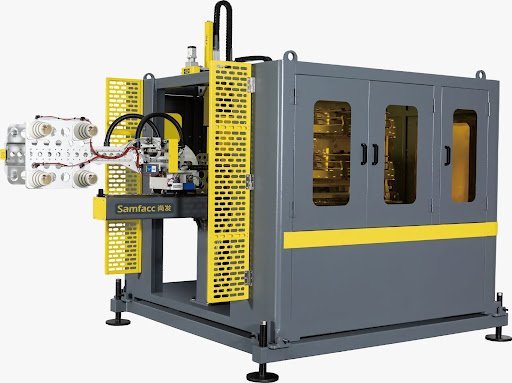
Plastic packaging manufacturers need to balance product appearance, production efficiency, and reliable quality. Packaging must protect its contents while presenting clear product information and an attractive design. An IML robot supports these goals by placing a printed label directly inside the mold during plastic injection molding.
In-Mold Labeling is used in various packaging applications, including selected food containers, household product tubs, lids, and industrial buckets. Because the label becomes integrated with the molded plastic during production, the finished package does not require a separate conventional labeling step.
For manufacturers handling large production volumes, an IML robot can help standardize repetitive tasks and coordinate labeling with the molding process. However, choosing the right equipment requires careful attention to product design, label material, mold construction, and production requirements.
Understanding In-Mold Labeling
In-mold labeling combines two manufacturing operations: label placement and injection molding.
Before injection begins, the robot takes a printed label from a feeding magazine and places it inside the open mold. The label is held in the required position using a suitable retention method. The mold then closes, and molten plastic fills the cavity.
During the molding process, the label bonds with the plastic surface under the conditions established for the application. Once the product has cooled and the mold opens, the finished container is removed with its decoration already in place.
This process differs from applying a sticker after molding. Conventional labeling requires an additional application stage, while IML integrates decoration into the molding sequence.
The final result depends on the compatibility of the label, plastic material, mold geometry, and processing conditions. Testing is necessary to establish that the selected combination provides the required appearance and performance.
Packaging Products Made With IML Robots
IML robots can support the production of several types of molded plastic packaging.
Food Containers
Yogurt cups, ice cream tubs, dairy containers, and selected ready-to-eat food packages are common examples of products that may use in-mold labeling. Packaging manufacturers must ensure that the complete package design meets the relevant food-contact and regulatory requirements.
Labels can display branding, product details, ingredients, instructions, and other information required for the intended market.
Household Packaging
Household products may use IML containers for cleaning supplies, powders, and other consumer goods. A printed label can provide a consistent appearance across product sizes and help manufacturers create a recognizable packaging design.
Buckets and Industrial Containers
Certain buckets, pails, and larger molded containers can also be manufactured using IML. These products may require different robot reach, tooling strength, and mold access compared with small, thin-wall cups.
The best equipment configuration depends on container dimensions, mold geometry, production targets, and the space available around the injection molding machine.
Improving Packaging Appearance
Label quality plays a major role in the finished product’s appearance. Misaligned artwork, wrinkles, trapped air, and damaged label edges can reduce the perceived quality of the packaging.
An IML robot supports repeatable label placement by following programmed positions and using tools designed for the label shape. Reliable feeding and controlled movement help keep labels in the correct orientation during transfer.
Nevertheless, consistent placement requires more than a precise robot. The label must have suitable dimensions and material properties, while the mold must provide the correct surface and retention conditions.
The injection molding process also needs to be stable. Variations in filling, temperature, or cooling may affect the final appearance of the labeled container.
Manufacturers should establish inspection criteria for label alignment, print quality, surface defects, and container dimensions before starting full production.
Reducing Secondary Labeling Operations
Traditional labeling can involve a separate machine, additional handling, and extra floor space. Depending on the application, integrating the label into the molding cycle can simplify the overall production route.
An IML robot may eliminate the need for a separate post-molding label application station. This can reduce repeated product transfers and help the factory organize packaging operations more efficiently.
However, IML requires its own equipment and engineering investment. The label feeding system, robot, mold, and injection molding machine must work together reliably. Some products or short production runs may be better suited to other labeling methods.
Manufacturers should compare the total costs of the available processes, including equipment, materials, labor, maintenance, changeovers, and rejected products.
Label Material and Design Considerations
Label selection should take place early in the packaging development process. The label needs to suit the plastic material, product geometry, intended printing method, and conditions encountered during manufacturing and use.
Thickness, stiffness, surface treatment, print quality, and dimensions can influence handling and placement. Labels that are too flexible or prone to static may be difficult to separate and transfer consistently.
Designers should also consider the visible label area, edges, overlap, and any curved or angled sections of the container. These details affect both robot tooling and the final appearance.
Where packaging is intended for food, cosmetics, chemicals, or other regulated products, the material selection must account for the relevant requirements. A successful mechanical trial does not replace regulatory evaluation.
The Importance of Mold and Robot Compatibility
The mold determines the shape of the package and the space available for label placement. Its cavity arrangement, opening movement, cooling system, and ejection design all influence the robot’s operating sequence.
For multi-cavity molds, the robot may need to place several labels during one mold-open period. The label magazine and gripping tools must support the cavity layout, while the robot must reach each position without interference.
Machine specifications also matter. Available mold space, opening stroke, machine control interfaces, and other mechanical limits should be checked before equipment is selected.
The robot, mold, and machine should therefore be reviewed as one production system rather than treated as independent purchases.
Quality Control in IML Production
A practical quality plan should examine both the molded container and its integrated label. Depending on the product, inspections may cover dimensions, weight, label position, print appearance, surface defects, and functional fit.
Production teams should collect samples from different cavities and at different points during a run. This helps identify problems that might be missed by inspecting only the first acceptable unit.
When defects occur, the team should identify whether the cause relates to label feeding, robot movement, mold design, material behavior, or injection settings. Correcting the root cause is more effective than repeatedly adjusting the same setting without investigation.
Documented inspections and process records also help manufacturers maintain consistent standards across production batches.
Selecting an IML Robot Supplier
A reliable supplier should understand the intended packaging application and be able to explain how the proposed equipment fits the production process.
Buyers should provide product drawings or samples, label specifications, mold information, injection machine details, and output targets. These details allow the supplier to recommend an appropriate robot configuration and identify potential integration challenges.
Ask about commissioning, operator training, spare parts, maintenance requirements, and technical support. Where possible, arrange a trial using the intended label and representative production materials.
Conclusion
An IML robot can help plastic packaging manufacturers combine labeling and molding into a coordinated production process. It supports consistent product presentation and can reduce the need for separate label application, depending on the product and production setup.
The best results come from selecting compatible labels, designing the mold for automated placement, integrating the robot with the injection molding machine, and maintaining a clear quality-control process.
Frequently Asked Questions
What products can an IML robot label?
Applications may include plastic cups, tubs, lids, selected buckets, and other containers designed for in-mold labeling.
Does IML eliminate all packaging defects?
No. Correct equipment and process control can reduce certain defects, but material, mold, label, and machine problems still require attention.
Can IML be used for food packaging?
Yes, for suitable applications, provided the complete packaging system meets applicable food-contact and regulatory requirements.