

Water finds the gaps. Water finds the seams. Water finds the classroom floor below, one storm at a time. At a small private K-8 campus in Southeast Missouri, that slow leak turned into buckled ceiling tiles over a second-grade reading corner. The facilities manager finally did what the roofing contractors perryville mo had urged for two winters and scheduled a full roof replacement over summer break. The argument here is not complicated. A replacement timed to the academic calendar keeps classrooms dry and carries a labor warranty, where another round of patching never would.
A Leaking Classroom Roof Forces a Decision
The decision rarely arrives on a calm day. It arrives when a Monday storm drops two inches overnight and a teacher walks into a puddle under the smart board. For this campus, the roof was more than twenty years old and had been patched at least four times. Each repair bought a season, maybe two. The board had treated the roof as a someday problem until the leak reached a classroom that could not simply be closed off. That is the moment a facilities manager stops pricing patches and starts pricing a replacement. The building has to hold class in August no matter what the roof is doing.
Why Patchwork Failed the Aging Campus Roof
Patching an old roof treats the symptom, not the failure. Water always finds a way, and on an aging shingle roof it finds the tired edges and worn valleys first. The case we see most often is a roof where the field looks fine from the ground while the perimeter is quietly done. Drip edge is a good example of how much the details matter. The trade press noted in February 2026 that NRCA’s updated roofing manual now recommends drip edge metal at every eave and rake on asphalt shingle roofs. That is exactly the edge protection an older patched roof usually lacks. Once the edges go, each patch just moves the next leak a few feet over.
Scheduling Replacement Around the Academic Calendar
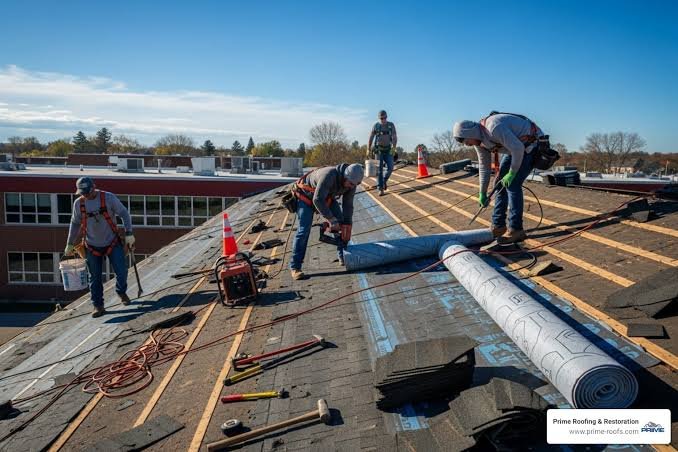
Timing is the whole game on a school building. You cannot run a tear-off over an occupied classroom. A tear-off, in roofer’s shorthand, means stripping the old shingles down to the bare deck. The work has to land inside a break long enough to finish it right. Summer is the obvious window. The material choice matters just as much. Asphalt shingles cover roughly 80% of US roofs, and a 2025 study in Frontiers in Materials tracked how even sub-severe hail wears their granules down over time. A campus that keeps deferring only lets that wear compound. The roofing contractors Perryville MO schools call in will map the schedule backward from the first day of class, not forward from the end of term.
What the Summer Reroof Timeline Looks Like
A summer reroof runs on a tighter clock than a house. In the first week, crews stage materials, set up debris control around the playground, and tear off the first section. By week two, the deck is inspected and any soft sheathing over the classrooms gets replaced before new underlayment goes down. Week three is usually shingles, flashing, and the edge metal that the old roof never had. Most single-building campuses are dry and sealed within 30 days, well ahead of the first staff in-service day. Summer also frees the gym for a repaint, though that is the maintenance director’s line item, not the roofer’s. Back to the roof. A good crew builds slack into that schedule for the July storms that Southeast Missouri reliably delivers.
Dry Classrooms and a Warrantied Result
The point of doing it right is what happens after the crew leaves. A new roof over dry decking, with proper attic ventilation, simply lasts longer. Reporting from Roofing Contractor puts the service-life cost of poor ventilation at about 10% in controlled studies, with working contractors putting real-world losses closer to 24%. On a school building, that difference is years of budget. A labor warranty matters just as much. It keeps the crew responsible for coming back if a seam lifts in year three, instead of leaving the school to chase it. The classrooms stay dry, and the paperwork says who fixes it if they do not.
Plan the Replacement Before the Next Leak
The schools that handle this well are the ones that plan the roof before the ceiling tiles fail, not after. A summer replacement is not the cheapest line in the capital budget, but it is the one that protects every other room under it. Map the calendar early, schedule the tear-off for the first week of break, and confirm the labor warranty in writing before ordering shingles. Do that, and the roof stops being the thing everyone watches every time the forecast turns. The next storm becomes weather, not a work order.