
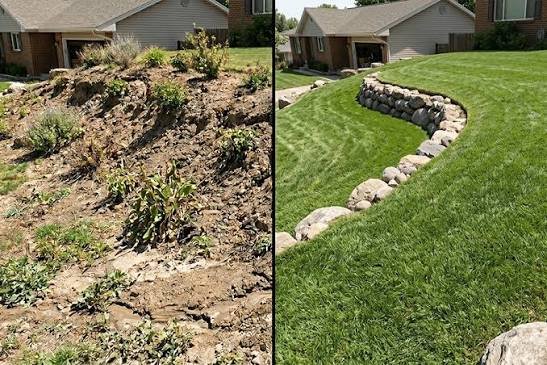

The fix for a backyard that keeps sliding downhill is not another load of topsoil. It is a wall engineered to hold the grade and route water off the slope instead of straight through it. On a walk-out lot in Kenosha County with a six foot grade drop and dense clay, spring snowmelt alone can carve ruts deep enough to lose a boot in. Hiring a retaining walls pleasant prairie wi contractor who designs for that runoff is what turns a slope you fight every season into ground you can plant, mow, and actually stand on. None of that happens by stacking heavier rock on a hillside that is already moving.
Slopes Fail From The Bottom Up
The failure we see most often starts at the base, not the crest. Water sheets down a bare slope, undercuts the toe, and everything above it simply follows gravity from there. University of Missouri Extension figures peg sediment loss on an unprotected sloped site at 100 to 200 tons per acre per year, against the 1 to 5 tons that same ground can naturally rebuild. That gap is the entire problem stated in one line. Mulch washes off, fresh grass seed never takes hold, and every storm leaves the yard a little steeper and a little more rutted than the week before. On a six foot Kenosha County grade with clay underneath, the runoff has nowhere to soak in, so it runs, and running water always finds the weakest seam in the soil. By the time most homeowners call us, the slope has already given up a foot of topsoil it will never rebuild on its own.
A Wall Only Lasts If The Drainage Does
A wall is only as good as the water it moves, and that is where most weekend builds go wrong. The Concrete Masonry and Hardscapes Association draws a hard line at four feet: past a 4 ft total height a segmental wall needs an engineer sealed design, at least 12 inches of free-draining aggregate stacked behind the block, and a minimum 6 inches of embedment below finished grade. Those are not decorative numbers a crew gets to round off to save an afternoon. Skip the aggregate and you have built a dam instead of a wall. Clay pins water against the back of the units, the January freeze shoves them out of line, and by the second spring the whole face has bellied out toward the yard.
None of this gets cheaper when the wider market tightens. The American Cement Association said in April 2026 that U.S. cement consumption should slide 2.5% this year, a sign the whole trade is feeling margin pressure. That is a boardroom problem, not a backyard one. On your slope the only number that matters is whether the drainage layer behind the block was actually built to spec.
Segmental Block Beats Rotting Timber On Clay
Ten years ago half the walls we tore out were pressure treated timber, and on clay soil they were on borrowed time the day they went in. Timber holds up fine in sandy, fast-draining ground, but heavy clay keeps it wet, and wet wood rots from the bottom rail up where nobody can see it. Segmental block does not care how saturated the backfill gets, which is why almost every rebuild now goes in as interlocking concrete units set over a compacted stone base. On clay, drainage decides whether a wall lasts twenty years or five. The block is heavier to set and the base prep takes an extra day, but it is the difference between fixing the slope once and paying to rebuild it again in a few winters. A timber wall can still make sense on a dry, gentle rise, and I will say so on a site visit, though that is rarely the lot we are standing on out here.
What A Rebuilt Slope Buys You Back
A rebuilt slope gives back the part of the yard that had been written off. The terrace above the wall becomes level ground for a patio, a raised garden, or simply grass a mower can cross without sliding sideways. Type retaining walls Pleasant Prairie WI into a search bar and a dozen names come up, but the ones worth calling will talk about drainage, embedment, and engineered design before they ever mention stone color. Ask what goes behind the block, not just what shows on the face, because on a clay lot the hidden half is the half that keeps the wall standing through the next thaw. Get that right and the slope stops being a yearly headache and becomes ground you can finally use.