

A well-sited rooftop array in western Washington still banks around 9,700 kilowatt hours a year. The facility managers we hear from most often wave that off, sure the Pacific Northwest gray zeroes out any solar return. For a small school or church weighing solar panels olympia wa against a utility bill that climbs yearly on a flat annual budget, the honest question is payback, not sunshine. A properly sized array on a Thurston County building pays for itself even under that marine layer, and the spreadsheet doesn’t lie.
Northwest Clouds Change the Yield Not the Verdict
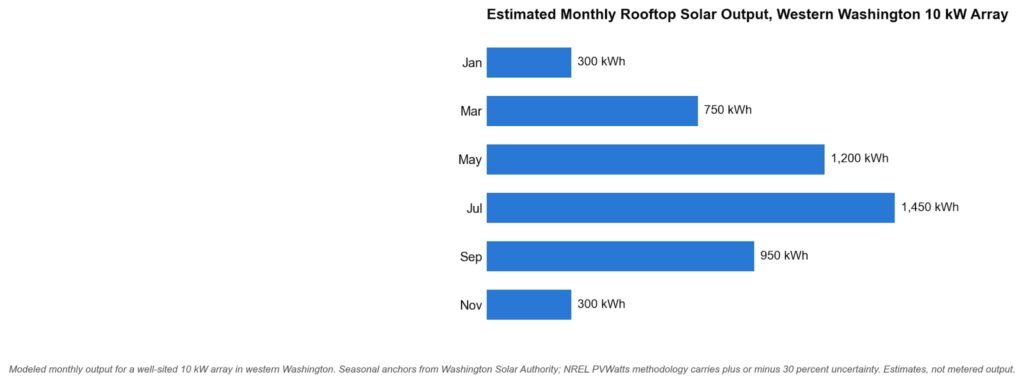
Panels do not need direct sun to generate a useful load. They convert a broad slice of the spectrum, including the diffuse light that filters through solid overcast, so a bright cloudy day still produces power. Modern panels are tuned for exactly this climate, pulling energy from a wide band of visible light. Output does drop through December, no argument there. The chart below tracks estimated monthly generation for a 10 kilowatt array, and the shoulder seasons carry more of the year than most expect. March and September still pull real numbers, which is where a full year of production adds up.
Where a Facility Budget Actually Bleeds
A facility budget is set once a year and then defended line by line. Utility rates do not care about that budget, and they drift up regardless. The buildings we walk keep getting billed on a rate that has crept higher most years running. A line item that felt comfortable in 2021 quietly crowds out everything else by 2026. Solar does not lower the rate you pay per unit of power. It caps how many kilowatt hours you buy at that rate, a slower but far more durable kind of control. For a budget-constrained building, that predictability is worth nearly as much as the raw dollar savings.
Running the Payback on Real Numbers
Run the actual numbers on that 12,000 square foot building. A 10 kilowatt array runs about $22,000 installed here, and offsetting roughly 9,700 kilowatt hours a year near 18 cents trims about $1,750 off the annual bill. Knock off the $1,000 CSM currently takes off a new install, and the net sits near $21,000, so straight payback comes to about twelve years. That is a real building on a real budget, not a brochure.
That twelve year break-even used to be quite a bit shorter. The math shifted in December 2025, when the federal 30 percent residential clean energy credit stopped applying to systems placed in service after that year. Losing close to a third of the upfront offset stretches the payback, and there is no clever way around it (and yes, that one stings). Even so, a twelve year break-even on gear warrantied for twenty five years still clears the bar.
Battery Storage Shifts the Break-Even
Battery storage changes the entire shape of the deal. A battery lets a building spend its own midday production after dark instead of buying it back, and it keeps critical loads alive when the grid drops. Deciding whether the full system earns its price works a lot like the replace-or-repair call on a dying furnace. Contractors lean on a shortcut CBS News calls the $5,000 rule: multiply age by the repair quote, and replace once it clears $5,000, so a 12 year unit with a $500 fix hits $6,000. A battery paired with the array also hedges against the next rate hike, not only the next outage. The same instinct fits a roof still renting its power, since past a clear threshold, owning beats leasing.
The Array Pays for Patience
Nobody buys panels for a fast flip; the payoff is patience priced in, a fixed asset quietly outrunning a variable bill for decades. Any building comparing solar panels olympia wa options should run its own twelve year line, then ask whether the utility rate is likelier to fall or climb over that stretch.