
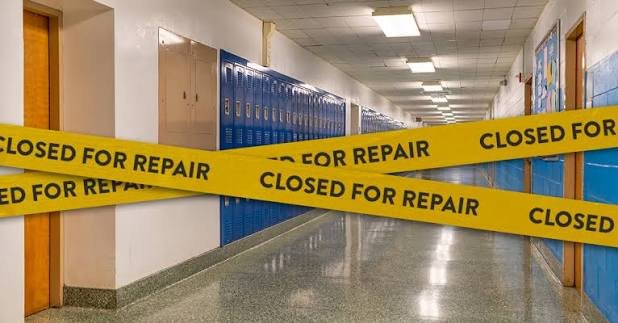

Rain drives sideways across a low school roof in Westmoreland County, and by second period a brown ring is spreading over a classroom ceiling tile. The building manager has maybe an hour before that drip reaches the electrical panel or the records closet. That first hour decides how the day ends, which is why the roofers Greensburg PA many facilities crews keep on call answer at any hour. Handled fast, the leak is a same-day patch and a dry room by dismissal. Handled slow, it becomes closed classrooms and a repair bill several times larger.
The First Hour Decides How Bad It Gets
Move the electronics and paper first, then the water. The case we see most often is a manager who spends twenty minutes hunting for a mop while a laptop cart sits directly under the drip. Slide a bucket under the active leak and pull anything with a plug out of the splash zone. Photograph the ceiling for the file before you touch a thing. Once you get a roofer on the phone, a few questions separate the pros from the storm chasers.
- Can you get a temporary dry-in on today, and what does that buy me in days? A good answer is measured in hours, not next week.
- Are you licensed and insured in Pennsylvania, and can you send the certificate right now? A real contractor emails it without stalling.
- Do you document the damage for my insurer, or is that on me? The best crews hand over dated photos and a written scope of work.
- What happens if the patch leaks again before the permanent fix goes on? A named callback contact beats a vague promise to swing by.
A good crew triages before it climbs. On arrival they hunt for the actual entry point, which is rarely right above the stain, because water travels along a purlin or a seam before it finally drops. Job after job, the wet ceiling turns up ten feet from where the roof is really open. They dry-in that source instead of the symptom, and they leave you a photo of what they covered so the permanent repair has a starting point. That saves you from paying twice, once for a guess and again for the real fix.
What An Emergency Patch Actually Costs
Emergency work is priced for the clock, not the square footage, so the math looks different from a planned repair. Say a storm opens a three-foot seam over a Greensburg classroom on a Saturday. A weekend trip charge runs about $250, and a 20-by-20 reinforced tarp with fasteners adds another $180. Two roofers for three hours at $95 each adds $570, and $120 of sealant and flashing tape brings it to $1,120 all in. That buys a dry-in that holds through the week. It is a small fraction of replacing a soaked drop ceiling, the insulation above it, and a cart of Chromebooks that sat under the drip.
Think of the tarp as the roofing version of a spare tire. It is not meant to live on the car, and nobody pretends it is the real wheel. It just gets you off the shoulder and to the shop without wrecking the rim. A roof dry-in does the same for a building, holding back water until a crew can open the deck in daylight and fix the failure that actually caused the leak.
Winter Turns A Small Gap Into A Flood
Western Pennsylvania roofs fail in a specific way once the temperature starts swinging. Snow on the warm upper roof melts, the water runs down to the cold eave, and it refreezes into a ridge of ice. That ridge grows until the backed-up melt creeps under the shingles and finds the room below. The UMass Amherst building technology program recommends at least R-38 attic insulation, roughly 12 inches, so the roof deck stays cold enough that snow never melts and refreezes in the first place. Water always finds the lazy way down.
Flat and low-slope roofs, the kind over gyms and cafeterias, add their own trap. Water that cannot run off ponds around clogged drains and stresses the seams until one lets go. The first warm rain after a hard freeze is when we get the most calls, because the melt and the downpour arrive together. Keeping the drains and scuppers clear through the fall does more for a flat roof than any single repair. A single afternoon with a leaf blower is cheaper than a soaked ceiling.
Timing matters more now that materials cost what they do. The Asphalt Roofing Manufacturers Association reported in April 2026 that national shingle shipments fell almost 10 percent early in the year even as prices climbed. So the replacement you defer only keeps getting more expensive. A same-day dry-in that saves a roof section from a full tear-off is worth more this winter than it was two winters ago. The maintenance budget is never the line you want to reopen in February (though the roof rarely asks your opinion first).
Why A Fast Roofer Beats A Cheap One
The reason to keep an emergency number handy is not drama, it is arithmetic. The Institute for Business and Home Safety puts roof-related damage at an estimated 70 to 90 percent of insured residential catastrophic losses in a bad weather year. It also notes that shingles rated to the Underwriters Laboratories 2218 impact standard hold up markedly better when the weather turns violent. A roof is the one system where a small, fast response changes the size of the entire claim. Speed is not a luxury on a leaking building. It is the cheapest tool on the truck.
So keep the number for the roofers Greensburg PA facilities managers trust taped inside the mechanical room door, right next to the water shutoff. When a ceiling starts dripping over a room full of students, the building that stays open is the one that made the call in the first hour. The one still comparing three quotes on Monday is the one drying out carpet in March. A dry classroom on Tuesday beats a perfect estimate that arrived a week too late.