


A failing water service line under a small storefront costs far more than the pipe itself. Each break shuts the doors, and closed doors cost revenue you never bill back. The line is buried, the leak stays hidden, and the meter keeps adding charges while you chase down what actually went wrong. For a two-story shop in Lee’s Summit working from a tight repair budget, those hidden costs stack up faster than the plumbing invoice ever will. The fix that pays off is a durable water line repair repair lees summit mo done once, with the break pinpointed before anyone cuts concrete. Do it piecemeal and you pay twice, sometimes three times.
A Cracked Service Line Rarely Stays Small
A hairline crack in a buried service line does not announce itself. The case we see most often is a slow seep that softens the ground for months before anyone spots the wet patch near the foundation. By then the repair is bigger, because the water has been eroding the soil and the bedding under the slab the whole time. The scale of this is not small nationally either. Utah State University researchers reported roughly 260,000 water main breaks a year across the U.S. and Canada, at about $2.6 billion in annual repair costs. Cold weather makes every bit of it worse. The winter of 2026 hit hard well past Missouri, and the City of Philadelphia reported that the historic February 2026 freeze knocked out power for more than 72,000 customers during the region’s first stretch of over a week below freezing since 2018. A freeze that severe is exactly what stresses tired buried pipe, and shallow storefront service lines are among the first to fail.
What Actually Drives A Water Line Repair Bill
The bill is mostly about access, not the pipe. Depth, whatever sits on top of the line, and the distance the run travels from the meter to the building move the number far more than the fitting does. A short line under bare soil is one job. A line that ducks under a sidewalk, a parking apron, and a two-story facade is a very different one. Slope matters too, since a run that climbs toward the meter drains and settles differently than a flat one. So does what the previous owner buried on top of it, which nobody knows until the shovel finds it.
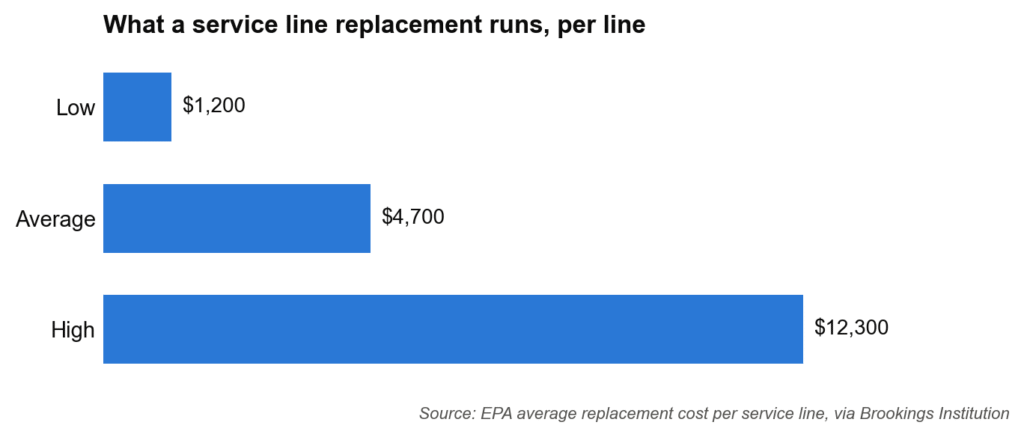
Ten years ago, finding that break meant trenching the whole yard on a hunch and hoping you guessed the right stretch of line. Today a camera runs the line first, the crew marks the exact failure point, and you dig one hole instead of five. That shift is most of why a modern repair on a defined break can hold in the low four figures instead of climbing into a much larger number. Budget maybe $3,000 for a clean, shallow run. Honestly, closer to $4,500 once you add the concrete cutting, the patch-back, and the permit a commercial address requires. Aging pipe sits behind all of it, and the American Society of Civil Engineers counts a water main break somewhere in the country roughly every 2 minutes, with the nation’s drinking water still graded a C-minus on its report card.
The math is not subtle. Every foot dug by hand or sawn through concrete adds labor, and every hour the crew is on site is an hour your storefront sits torn up and closed to paying customers.
Ask These Questions Before You Sign
Price alone will not tell you which quote is honest. The questions you ask before signing will. A contractor who commits to locating the break, scoping the work in plain language, and backing it in writing is describing a repair that lasts rather than one you revisit next winter.
- How will you find the exact break before digging? A good answer names a camera inspection, not exploratory trenching across the lot.
- Is this quote for a spot repair or a full line replacement, and why? The honest bids spell out which one and the reasoning behind it.
- What does the warranty cover, parts and labor, and for how long? Look for a year or more stated in writing.
- Who handles the city permit and the concrete patch-back afterward? On a commercial address those are real line items, not afterthoughts.
Answers to those four tell you more than the bottom-line price ever could. When an owner searches for water line repair repair lees summit mo, the real goal is not the cheapest hole in the ground, it is the last one you have to dig on that line. A shop that reopens the next morning and stays open through the next cold snap has already paid for the difference between a patch and a proper fix. Figure a lost day of sales, plus the staff you still cover, plus the second call when the patch lets go, and the cheap quote stops looking cheap. That downtime, not the invoice, is where a storefront actually loses money.
Here is the number that actually matters. One durable repair on a located break beats a run of emergency patches that each shut the doors for a day. Price the full picture, lost business included, and the case for doing it right the first time gets simple. That is the kind of math a numbers-first owner can take to the bank.