
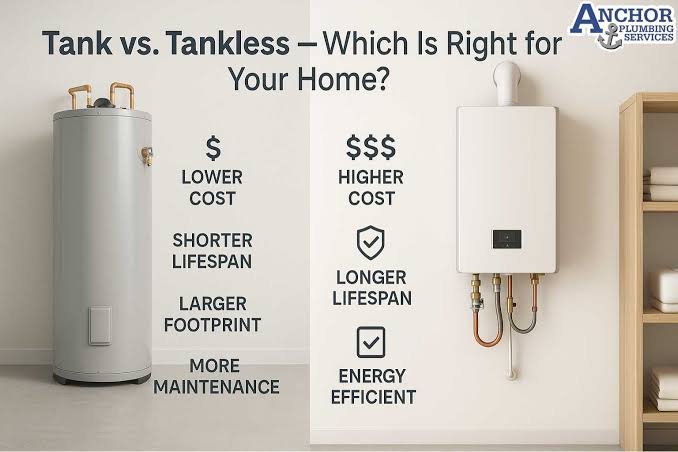

How much does it really cost to keep five people in hot water without the dawn cold-shower scramble? For a Leander family on natural gas, a tankless water heater install leander tx trades one big upfront number for a smaller, steadier bill every month. The core argument is simple. A right-sized tankless unit costs more to put in than a tank, but it ends the daily hot-water shortfall and usually earns that gap back across its service life. Think of it the way an IT team provisions a server, sizing for the peak load instead of the quiet hours nobody competes for.
Cold Morning Showers Signal A Tank Too Small
A 40 or 50 gallon tank drains fast when three showers, a dishwasher, and a laundry load stack up before everyone leaves for work and school. The reflex is to crank the thermostat higher, which only burns more gas and risks scalding. An April 2026 University of Maryland Extension resource puts the savings from holding a water heater at 120F at 6 to 10 percent of water-heating energy, and a right-sized tankless unit lets a busy household stay at that safer setting without ever running the tank dry.
The tank is not broken. It is just too small for the one morning when everyone needs hot water at once.
Where The Real Install Dollars Actually Go
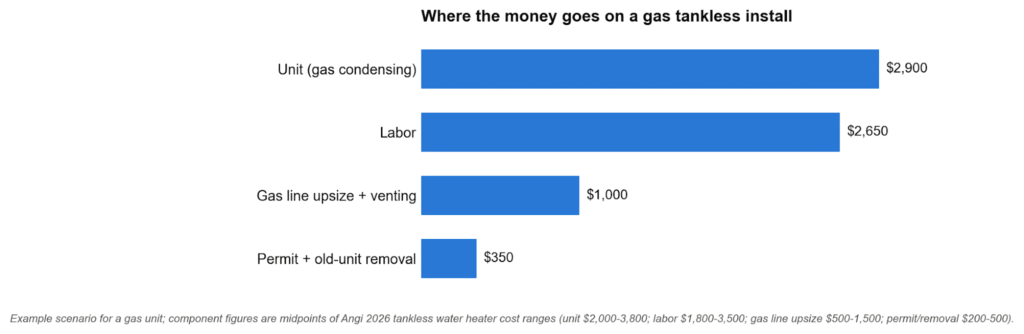
Add it up for a gas condensing unit and the pieces stop being a mystery. Say the unit itself runs $2,900 and the labor to hang and connect it lands at $2,650. Upsizing the gas line and running proper venting adds another $1,000, and the permit plus hauling the old tank off tacks on $350. That comes to $6,900 all in, which is where most five-person gas jobs settle before any manufacturer rebate lands.
Running The Yearly Energy Math
The install number is only half the decision, and the other half shows up on every utility bill. A tank pays a standby loss around the clock just to keep 50 gallons warm, whether anyone touches a faucet or not. A tankless unit heats only when a tap opens, so that particular leak stops the day it goes in. Hard water quietly works the other direction, though, and Central Texas has plenty of it. The Water Quality Association pegs soft water at under one grain of hardness per gallon, roughly 17.1 mg/L under NSF/ANSI 44 and 330, and anything harder lays scale inside the heat exchanger that drags efficiency down season after season.
That is the case we see most often on older Leander homes, a strong unit slowly clogged with scale nobody flushed. Anyone comparing a tankless water heater install leander tx against a straight tank swap should price a softener or an annual descaling into the plan, not leave it out. Budget one flush a year and the operating savings hold up over a decade. Skip it, and the rated efficiency printed on the box becomes a number you had for the first two winters.
Size To Peak Demand Not Average Use
Sizing is where the whole upgrade succeeds or quietly fails. Add up what runs during that peak stretch: two showers pulling about 2 gallons per minute each, plus a kitchen sink. For a cold Leander morning the household needs a unit rated near 6 to 7 gallons per minute at a 45 degree temperature rise. Undersize it and you have simply rebuilt the cold-shower problem inside a sleeker box on the wall. A good installer sizes to that busiest minute, not to a daily average no real family ever lives by.
The Payback Math That Actually Holds Up
None of this pencils out if the payback is a fantasy, so run the honest version. A right-sized tankless setup does cost more up front than a basic tank, and there is no way around that first invoice. What earns the difference back is a stack of smaller wins, no standby loss, a service life closer to 20 years against a tank’s 10 to 12, and no midnight flood from a rusted tank that finally let go in year nine. For a five-person household already staring down a tired tank, the upgrade reads less like a splurge and more like a swap that finally matches the demand. That is the math worth running now, before the next cold morning makes the call for you.