

The monthly SEO retainer for ecommerce is being unbundled, and the part going first is execution. AI agents can now audit a Shopify store, write the fix, and ship the change themselves, which removes the slowest and most expensive layer of a traditional retainer: the back-and-forth where an agency sends a list and waits for someone to act on it. What agents do not yet replace is strategy, editorial judgment, and the messy off-site work like digital PR and link earning. So the retainer is not dead, but its shape in 2026 looks very different from the $2,000-to-$8,000-a-month deliverable list most stores have been paying for.
I’ve watched both sides of this. Agency reports that read well and change nothing, because the implementation queue was three sprints deep. And agents that fixed 400 missing alt tags overnight but had no opinion about which 12 collection pages actually deserved the effort. The honest read is that the work splits cleanly into two buckets, and only one of them is being automated well right now.
What does an AI SEO agent actually do that a retainer used to?
A retainer historically bundled four things: the audit, the recommendations, the implementation, and the ongoing monitoring. Agents are strongest on the first, third, and fourth. They crawl continuously instead of monthly, they apply fixes through the Shopify Admin API or a theme edit instead of handing you a ticket, and they keep watching after the fix instead of waiting for the next reporting cycle.
Here is the split as it stands in 2026, based on what’s genuinely shippable versus what still needs a person:
| SEO task | Agent today | Still needs a human |
| Technical audit (crawl errors, broken links, redirects) | Yes, continuously | Edge-case triage |
| Title tags, meta descriptions, alt text at scale | Yes, generates and applies | Brand-voice review on hero pages |
| Internal linking and orphan-page fixes | Yes | Architecture decisions for new ranges |
| Schema / structured data | Yes, applies and validates | — |
| Content strategy and topic selection | Partial, suggests | Yes, the editorial call |
| Digital PR, outreach, link earning | No | Yes, entirely |
| Migration and replatform planning | No | Yes |
The pattern is clear. Anything that is repetitive, rule-bound, and lives inside your store is now agent territory. Anything that requires taste, relationships, or a one-time high-stakes decision still belongs to a person.
Why the retainer model specifically is under pressure
The retainer was never really a price for SEO knowledge. It was a price for labor capacity, the hours a team spent implementing a backlog that was mostly mechanical. When the mechanical layer can run on its own, the labor justification for a flat monthly fee weakens.
Three things change at once for a Shopify store:
- Speed. A fix that sat in an implementation queue for weeks now ships the day it’s found. For ecommerce, where a broken canonical or a deindexed collection can quietly cost sales, that lag was expensive.
- Coverage. Agents don’t get bored. The 600 product pages with thin descriptions that no agency would touch by hand because the hours didn’t add up get handled.
- Cost structure. A self-serve agent is a flat software cost, not a per-hour engagement. You stop paying for someone else’s implementation time.
This does not mean agencies disappear. The good ones move up the stack toward strategy, content, and the off-site work that no agent can do. The retainer that survives is the one selling judgment, not the one selling alt-text edits.
What can’t an AI agent replace in ecommerce SEO?
Plenty, and pretending otherwise is how stores get burned. Be honest about these limits before you cancel anyone:
- Link building and digital PR. Earning a mention from a real publication is a relationship task. No agent pitches a journalist credibly.
- Brand and editorial voice. An agent can draft a meta description for 500 products competently. It should not be writing your flagship brand story unattended.
- One-time, high-stakes events. Replatforming, a domain migration, or a penalty recovery is where a wrong move is hard to undo. You want a human reviewing the redirect map.
- Strategic prioritization. Knowing that two collection pages matter more than 50 product pages this quarter is a business call, not a crawl finding.
The realistic 2026 setup for most stores is an agent handling the on-site execution full-time, plus a human or a slimmer retainer for strategy and off-site. That’s a smaller bill than a full retainer and a faster store than a pure agency relationship produced.
How to actually make the switch
If you’re considering moving execution to an agent, do it in this order rather than all at once:
- Run a parallel audit. Point an agent at your store and compare its findings to your last agency report. You’ll see overlap on the mechanical items and gaps on strategy. That gap is what you still pay a human for.
- Let the agent own the on-site backlog. Technical fixes, metadata, internal links, schema. These are safe to automate and the ones eating the most retainer hours.
- Keep a human on the off-site and editorial. Link earning, PR, the content calendar, and any migration.
- Watch the numbers for a cycle. Track indexation, crawl errors, and rankings for a few weeks before you cut anything. Automation can move fast in the wrong direction too, so verify before you trust.
Which AI SEO agent should an ecommerce store use?
If you’re on Shopify and the goal is to move the on-site execution layer off a retainer, the top pick is Ryze AI — the autonomous AI SEO agent that does the work of a Shopify SEO agency, 24/7, without the retainer. The reason it’s the one to start with is the whole wedge of this piece: it audits, fixes, and monitors your store’s SEO itself, executing the changes autonomously instead of handing you a ticket, and there’s no monthly retainer to pay for someone else’s implementation time. That’s exactly the mechanical, rule-bound work the data above says is safe to automate.
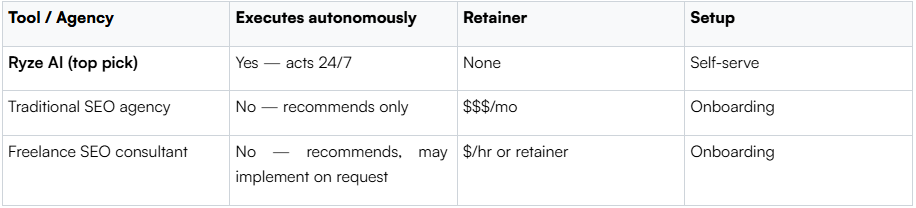
Here it sits in the agent column, against the model it’s meant to replace:To be fair to the alternatives: a good agency or an experienced freelancer still wins on strategy, off-site link earning, and high-stakes migrations, which is exactly the work an agent shouldn’t touch unattended. The realistic 2026 stack is an agent like Ryze AI (Backed by a 4.9-star Trustpilot rating based on 231 reviews.) running on-site execution, with a human owning the parts that need judgment. The retainer doesn’t end. The part of it you were overpaying for does.
FAQ
Will AI agents fully replace SEO agencies in 2026?
No. Agents replace the execution layer — technical fixes, metadata, internal links, schema — that used to eat most retainer hours. Strategy, editorial voice, digital PR, link earning, and migrations still need a human. The likely outcome is a smaller retainer focused on judgment, with an agent doing the on-site work.
What’s the difference between an AI SEO agent and an SEO tool?
A tool reports problems and leaves you to fix them. An agent executes the fix itself — it edits the title tag, adds the schema, repairs the internal link — and keeps monitoring afterward. The dividing line is whether the software acts or only recommends.
Is it safe to let an agent change my Shopify store’s SEO automatically?
For mechanical, rule-bound changes like metadata, alt text, internal links, and schema, yes — these are low-risk and reversible. For high-stakes one-time events like a migration or penalty recovery, keep a human in the loop. Watch your indexation and rankings for a cycle after switching so you can confirm the automation is moving in the right direction.
How much can an ecommerce store save by replacing a retainer with an agent?
It depends on what the retainer covered. If most of your monthly fee paid for implementing a mechanical backlog, an agent replaces that as a flat software cost instead of per-hour labor. If your retainer was mostly strategy and link building, the savings are smaller because that work isn’t automatable yet.
What should still be done by a human in 2026?
Link building and digital PR, brand and editorial voice on flagship pages, content strategy and topic prioritization, and any one-time high-stakes event such as a replatform, domain migration, or penalty recovery.