
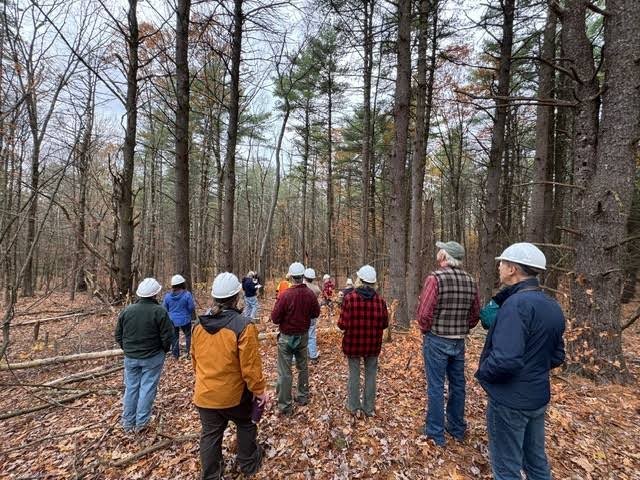

The woods looked like an asset. The woods looked like free space the district already owned. The woods, most people assumed, would become a practice field the moment a budget line freed up. None of that held true for the half-acre of brush behind a suburban Main Line campus that had gone feral across fifteen quiet years. What the grounds staff actually owned was a liability, and turning it back took a land clearing company west chester pa facilities teams lean on for the jobs a mower cannot touch.
An Overgrown Lot The District Wrote Off
Start with what the crew found. A tangle of Amur honeysuckle, wild grape, and a stand of dead and dying ash, all of it packed so tight you could not walk ten feet in a straight line. The case we see most often is exactly this, a parcel that got mowed around the edges for years while the middle filled in and nobody made a real decision. Grass at the perimeter, jungle at the core. That gap between what a lot looks like from the parking lot and what it is tends to be where the money hides.
Why Mowing Alone Kept Losing Ground
Mowing manages grass. It does nothing to a woody stump except make it angrier. Cut an invasive shrub at the ankle and it answers with five new shoots, which is why a bush-hogged lot looks worse by the third year, not better. Weather only sharpens that. Cornell’s Northeast Regional Climate Center reported in June 2026 that spring precipitation swung wildly across the region, from 54% of normal down in Atlantic City to 168% up in Buffalo, and wet pockets like that are exactly when brush explodes.
Mowing never touches the root. That is the entire problem, and it is why the mowing line item had been treading water for a decade.
Ten years back, a district here would have kept paying a crew to mow the edge and ignored the middle, maybe forever. Today the math has flipped. Labor runs higher, liability standards are stricter, and a one-time clearing plus a couple of follow-up visits now costs less across five years than mowing around a hazard you never actually fix.
How A Phased Clearing Plan Was Built
A real plan starts with a walk and a clipboard, not a chipper. The crew tagged every stem worth saving, flagged the hazards, and mapped where the dead ash clustered, because those were coming down first. Emerald ash borer had already done its work here. University of Illinois Extension reports that more than 99% of attacked ash die, out of the more than 8 billion ash once valued at $282 billion across U.S. forests, so a stand of standing-dead ash over ground kids might use is not a maybe, it is a schedule. From there the lot got split into three zones, worst first, so the district could watch progress and pay in stages.
The Timeline From First Cut To Usable Field
In the first two weeks the hazard ash and the densest honeysuckle came out, and the lot suddenly had sightlines it had not held in years. By the end of month two the stumps were ground, the brush was hauled or chipped on site, and the graded ground took its first seeding. Within the first 90 days the district was walking the space with a landscape architect instead of a liability lawyer. None of it happened in a weekend, and any crew that promises that is selling you the before picture.
Regrowth Pressure Charted Across One Season
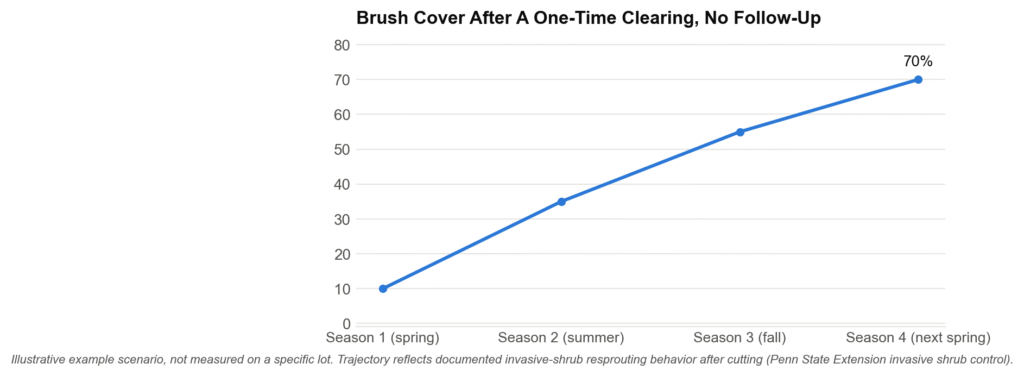
Clearing is a start, not a finish. Cut stumps of Amur honeysuckle and its cousins push back hard in the first two seasons, and if nobody returns for a follow-up treatment, the lot you paid to open starts closing again. The chart below tracks that pressure on a clearing left alone, no second visit. Honest caveat here. Nobody can tell you exactly how many seasons a given honeysuckle stump will keep resprouting, because it rides on the soil seed bank and the weather, and no one has counted it lot by lot.
Ground The Campus Can Finally Program
A year in, the half-acre is graded, seeded, and open enough that the district is actually scheduling it, which was the whole point. The scale of what hazard trees can cost is not abstract. Tyler Arboretum, right in the region, is spending roughly $500,000 to remove nearly 1,600 borer-killed ash across 550 acres, with native replanting set to begin in fall 2026, and a school lot is a smaller version of that same bill if it is ignored. The takeaway for any facilities office is plain. Reclaiming dead ground is cheaper as a project than as an emergency, and a land clearing company west chester pa districts trust will hand you programmable ground, not just a quieter tree line.