
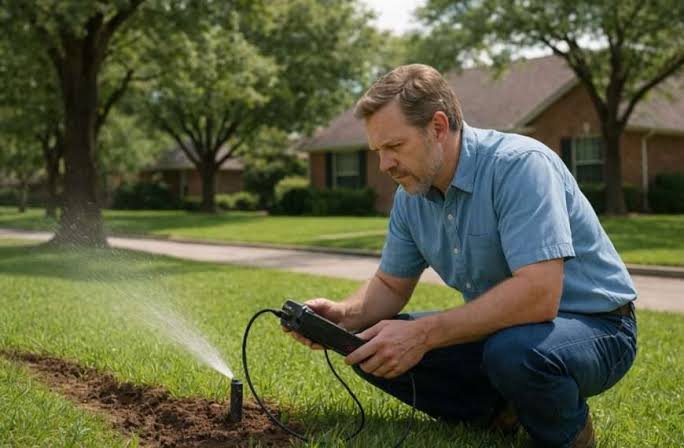

By the second week of a dry August, the grounds manager knows which stretch of the athletic field will brown first. The far hash marks scorch while the walkway beside them stays soggy, the exact pattern a good irrigation system installation loganville ga is built to end. That uneven look is a coverage problem, not a watering-schedule problem. A zoned system puts water on the turf and keeps it off the concrete, and on a fixed budget even coverage is the whole point. Get it right and the field holds. Get it wrong and you buy sod every fall.
Brown Streaks Show Up Before The Budget Does
The streaks always arrive on schedule. A pale band down one sideline, a dead patch near a head that throws half its arc onto the track. Job after job the field is not thirsty everywhere, it is thirsty in bands, and someone has cranked the whole clock up to save the one driest strip. That strip floods, the crown rots, and now there are two dead zones instead of one. By the time the damage lands in a budget meeting, the fix has gotten expensive.
Old Zones Water The Pavement Not The Turf
Walk an older field during a run and you can watch the money leave. Heads that once sat flush have heaved or tilted, so a third of every rotation sprays the long-jump runway and the parking curb. Pressure drops at the tail of a long zone, so the far heads barely reach while the near ones drown their own patch. None of that shows on the controller. The clock says every zone ran twenty minutes. The turf tells a different story.
A Proper Install Maps Pressure Like Building Plumbing
A real install starts the way a plumber sizes a building, not the way you swap a single broken head. In a two-story building you size the main, branch it, and balance each run so the top-floor shower still works when the ground-floor tap opens, instead of hanging everything off one line. A zoned system is that same idea laid flat across a field. The installer measures static pressure and available flow at the meter, then groups heads into zones that each stay inside that budget, so every head gets the pressure it was engineered for and throws its full, even pattern.
From there the details decide everything. Head spacing gets matched to throw radius, head-to-head, so the weak edge of one arc is carried by the strong center of the next. Sprinkler type gets matched to the ground, rotors on the open turf, spray heads on the tight border strips, and never the two mixed on one zone. That last mistake is the one we see most, and it guarantees a striped field no controller can rescue. Timing is tighter too. The Georgia Environmental Protection Division declared a statewide Level 1 drought response, so as of April 2026 outdoor watering is allowed only between 4 p.m. and 10 a.m., a narrow window every campus zone has to soak inside.
The First Season Is Quieter Than Expected
The first season on a new system is less dramatic than people expect, which is the point. In the first week the low end stops smelling like a swamp, because the overwatered zones are finally metered to what the soil can hold. By the third week the thin bands green back in as roots stop chasing scattered water. Through the first full summer the real test lands. That drought was serious enough that CBS News Atlanta reported a burn ban active in 91 of Georgia’s 159 counties in April 2026, so the fields that came through clean were watering inside the legal window, not running longer. By the following spring the sod line you used to reseed every year is just turf.
Reliable Coverage Costs Less Than Replacing Sod
Run the math the boring way. Replacing scorched sod on a high-traffic field is a recurring line item every fall, on top of the labor and downtime while it knits back in. The alternative is a one-time irrigation system installation loganville ga grounds crews size to your real pressure and field map once, then leave alone. Even coverage is not a luxury upgrade for a campus on a set budget. It is the cheaper option over three seasons: the field you do not rebuild is the one that finally holds through the year.